Advertisements
Advertisements
Question
Focal length : metre : : power of lens : _______
Advertisements
Solution
Focal length : metre : : power of lens : dioptre
APPEARS IN
RELATED QUESTIONS
Calculate the focal length of a corrective lens having power +2.5 D.
State the power of a lens S.I. unit.
A doctor has prescribed a corrective lens of power +1.5 D. Find the focal length of the lens. Is the prescribed lens diverging or converging?
A student uses a lens of focal length 40 cm and another of –20 cm. Write the nature and power of each lens
Consider two statements A and B given below:
A: real image is always inverted
B: virtual image is always erect
Out of these two statements:
Name the physical quantity whose unit is dioptre.
How is the power of a lens related to its focal length?
What is the power of a convex lens lens whose focal length is 80 cm?
A diverging lens has focal length of 3 cm. Calculate the power.
The focal length of a lens is +150 mm. What kind of lens is it and what is its power?
A diverging lens has a focal length of 0.10 m. The power of this lens will be:
How is the sign (+ or -) of power of a lens related to its divergent or convergent action?
A normal eye is not able to see objects closer than 25 cm because
A double convex lens has focal length 25 cm. The radius of curvature of one of the surfaces is double of the other. Find the radii, if the refractive index of the material of the lens is 1.5.
A convex lens produces a double size real image when an object is placed at a distance of 18 cm from it. Where should the object be placed to produce a triple size real image?
How is accommodation produced?
Which lens has more power a thick lens or a thin lens?
A stick partly immersed in water appears to be bent. Draw a ray diagram to show the bending of the stick when placed in water and viewed obliquely from above.
If the lens is of focal length 25 cm. Calculate the power of the lens.
If there is a convex lens of focal length 75 cm and a concave lens of focal length 40 cm, then calculate their combined power and combined focal length.
According to Rayleigh’s scattering law, the amount of scattering of light is inversely proportional to the fourth power of its ______.
The power of lens depends on the focal length of the lens
Increase in the converging power of eye lens cause ‘hypermetropia'
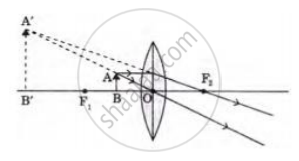
The above lens has a focal length of 10 cm. The object of height 2 mm is placed at a distance of 5 cm from the pole. Find the height of the image.
A convex lens with radii of curvature R1 = R2 is immersed in water. Assuming that the refractive indices of glass and water are 3/2 and 4/3 respectively, its focal length f1 in comparison to that in air, f, is ______.
A point object is placed at O in front of a glass sphere as shown in figure.

Show the formation of the image by the sphere.
When monochromatic red light is used instead of blue light in a convex lens, its focal length will ______.
In what unit is the power of a lens expressed?
The power of a lens is defined as the:
A convex lens is a converging lens whose focal length and power are both:
When a lens is placed in a liquid, the total power of the lens is:
For a lens immersed in a medium of refractive index \[n_1\], the power is related to the focal length by:
If the refractive index of the lens material is less than that of the surrounding liquid (\[n_2 < n_1\]), then:
A convex lens has:
