Advertisements
Advertisements
Question
The power of lens depends on the focal length of the lens
Options
True
False
Advertisements
Solution
True
APPEARS IN
RELATED QUESTIONS
Which one of the following materials cannot be used to make a lens?
Name the physical quantity whose unit is dioptre.
Which type of lens has a positive power?
What is the power of a convex lens of focal length 0.5 m?
What is the nature of a lens having a power of + 0.5 D?
Surabhi from std. X uses spectacle. The power of the lenses in her spectacle is 0.5 D.
Answer the following questions from the given information:
- Identify the type of lenses used in her spectacle.
- Identify the defect of vision Surabhi is suffering from.
- Find the focal length of the lenses used in her spectacle.
The following diagram shows the object O and the image I formed by a lens. Copy the diagram and on it mark the positions of the lens LL’ and focus (F). Name the lens.
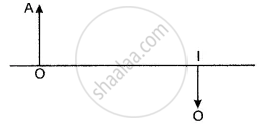
If focal length of a convex lens is 20 cm at what is the power of the lens?
The lens of power + 1·0 D is ______.
A concave lens has:
