Advertisements
Advertisements
Question
What is the nature of a lens having a power of + 0.5 D?
Advertisements
Solution
Positive sign indicates it is a converging lens. Therefore, the lens is convex.
RELATED QUESTIONS
Calculate the focal length of a corrective lens having power +2D.
What is the focal length of a convex lens of focal length 30 cm in contact with a concave lens of focal length 20 cm? Is the system a converging or a diverging lens? Ignore thickness of the lenses.
The lens mentioned in 6(b) above is of focal length 25cm. Calculate the power of the lens.
A student uses a lens of focal length 40 cm and another of –20 cm. Write the nature and power of each lens
What can you see in a completely dark room? If you switch on an electric bulb in this dark room as a light source, explain how you could now see:
(a) the electric bulb
(b) a piece of white paper
Which has more power : a thick convex lens or a thin convex lens, made of the same glass? Give reason for your choice.
The focal length of a convex lens is 25 cm. What is its power?
What is the power of a convex lens lens whose focal length is 80 cm?
What is the nature of a lens whose power is, −4 D?
Fill in the following blank with suitable word:
For converging lenses, the power is __________ while for diverging lenses, the power is ___________.
A convex lens of focal length 25 cm and a concave lens of focal length 10 cm are placed in close contact with one another.
(a) What is the power of this combination?
(b) What is the focal length of this combination?
(c) Is this combination converging or diverging?
A diverging lens has a focal length of 0.10 m. The power of this lens will be:
State the condition for the following a lens has both its focal lengths equal .
The power of a lens is + 1.0 D is :
Find the radius of curvature of the convex surface of a plano-convex lens, whose focal length is 0.3 m and the refractive index of the material of the lens is 1.5.
A symmetric double convex lens is cut in two equal parts by a plane containing the principal axis. If the power of the original lens was 4 D, the power of a divided lens will be
A convex lens produces a double size real image when an object is placed at a distance of 18 cm from it. Where should the object be placed to produce a triple size real image?
A lens forms an upright and diminished image of an object, irrespective of its position. What kind of lens is this? Draw an outline ray diagram to show the formation of the image. State the position and one more characteristic of the image.
Complete the diagram to show the formation of the image of the object AB.
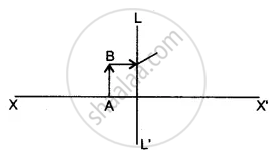
(i) Name the Lens LL’.
(ii) Where is the image of the object AB formed?
(iii) State three characteristics of the image.
If there is a convex lens of focal length 75 cm and a concave lens of focal length 40 cm, then calculate their combined power and combined focal length.
Focal length : metre : : power of lens : _______
The power of the magnifying glass depends on the distance of the magnifying glass from object.
Match the following:
| Column - I | Column - II | ||
| 1 | Retina | a | Path way of light |
| 2 | Pupil | b | Far point comes closer |
| 3 | Ciliary muscles | c | near point moves away |
| 4 | Myopia | d | Screen of the eye |
| 5 | Hypermetropia | e | Power of accommodation |
The focal length of a concave lens is 20 cm. The focal length of a convex lens is 25 cm. These two are placed in contact with each other. What is the power of the combination? Is it diverging, converging or undeviating in nature?
A convex lens with radii of curvature R1 = R2 is immersed in water. Assuming that the refractive indices of glass and water are 3/2 and 4/3 respectively, its focal length f1 in comparison to that in air, f, is ______.
A point object is placed at O in front of a glass sphere as shown in figure.

Show the formation of the image by the sphere.
An object is kept at a distance of 1m from a lens of power +2D:
- Identify the type of lens.
- Calculate its focal length and distance of the image formed.
A convex lens has:
The power of a lens of focal length \[f = 0.5\,m\] is:
