Advertisements
Advertisements
Question
A diverging lens has focal length of 3 cm. Calculate the power.
Advertisements
Solution
Given: f = −3 cm = −0.03 m (Diverging lens)
Formula: Power (P) = `1/f`
∴ P = `1/(-0.03)`
= `100/-3`
= −33.33 D
APPEARS IN
RELATED QUESTIONS
Define 1 dioptre of power of a lens.
Ranbir claims to have obtained an image twice the size of the object with a concave lens. Is he correct? Give a reason for your answer.
Consider two statements A and B given below:
A: real image is always inverted
B: virtual image is always erect
Out of these two statements:
Which one of the following materials cannot be used to make a lens?
Which type of lens has a positive power?
The focal length of a lens is +150 mm. What kind of lens is it and what is its power?
State the condition for the following a ray passes undeviated through the lens .
Express the power (with sign) of a concave lens of focal length 20 cm.
Name the type of lens whose power is positive.
The image of an object formed by a lens is real, inverted and of the same size as the object. If the image is at a distance of 40 cm from the lens, what is the nature and power of the lens ? Draw ray diagram to justify your answer.
Define power of a lens. Write its units. Deduce the relation `1/f =1/f_1 +1/f_2`for two thin lenses kept in contact coaxially.
Consider three converging lenses L1, L2 and L3 having identical geometrical construction. The index of refraction of L1 and L2 are \[\mu_1 \text{ and } \mu_2\] respectively. The upper half of the lens L3 has a refractive index \[\mu_1\] and the lower half has \[\mu_2\] following figure . A point object O is imaged at O1 by the lens L1 and at O2 by the lens L2placed in same position. If L3 is placed at the same place,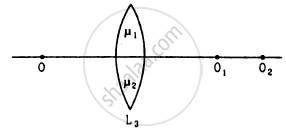
(a) there will be an image at O1
(b) there will be an image at O2.
(c) the only image will form somewhere between O1 and O2
(d) the only image will form away from O2.
Surabhi from std. X uses spectacle. The power of the lenses in her spectacle is 0.5 D.
Answer the following questions from the given information:
- Identify the type of lenses used in her spectacle.
- Identify the defect of vision Surabhi is suffering from.
- Find the focal length of the lenses used in her spectacle.
If the lens is of focal length 25 cm. Calculate the power of the lens.
If there is a convex lens of focal length 75 cm and a concave lens of focal length 40 cm, then calculate their combined power and combined focal length.
The power of lens depends on the focal length of the lens
When monochromatic red light is used instead of blue light in a convex lens, its focal length will ______.
The power of a lens in dioptres is given by:
A greater numerical value of the power of a lens means:
If the refractive index of the lens material is less than that of the surrounding liquid (\[n_2 < n_1\]), then:
