Advertisements
Advertisements
Question
A double convex lens has focal length 25 cm. The radius of curvature of one of the surfaces is double of the other. Find the radii, if the refractive index of the material of the lens is 1.5.
Advertisements
Solution
Given,
Double convex lens of focal length, f = 25 cm
Refractive index of the material, μ = 1.5
As per the question, the radius of curvature of one surface is twice that of the other.
i.e. R1= R and R2= −2R
(according to sign conventions)
Using the lens maker formula
\[\frac{1}{f} = (\mu - 1)\left[ \frac{1}{R_1} - \frac{1}{R_2} \right]\]' we have:
\[\frac{1}{25} = \left( 1 . 5 - 1 \right)\left[ \frac{1}{R} - \left( \frac{1}{- 2R} \right) \right]\]
\[\Rightarrow \frac{1}{25} = 0 . 5\left[ \frac{3R}{2} \right]\]
\[ \Rightarrow \frac{1}{25} = \left[ \frac{3R}{4} \right]\]
\[ \Rightarrow R = 18 . 75 \text{ cm }\]
R1 = 18.75 cm and R2 = 37.5 cm
Hence, the required radii of the double convex lens are 18.75 cm and 37.5 cm.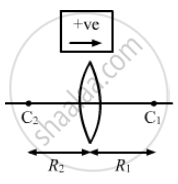
APPEARS IN
RELATED QUESTIONS
Calculate the focal length of a corrective lens having power +2.5 D.
What is meant by a power of a lens? Define its SI unit.
What does sign of power (+ve or –ve) indicate?
A convex lens forms a real and inverted image of a needle at a distance of 50 cm from it. Where is the needle placed in front of the convex lens if the image is equal to the size of the object? Also, find the power of the lens.
You have two lenses A and B of focal lengths +10 cm and –10 cm, respectively. State the nature and power of each lens. Which of the two lenses will form a virtual and magnified image of an object placed 8 cm from the lens? Draw a ray diagram to justify your answer
Ranbir claims to have obtained an image twice the size of the object with a concave lens. Is he correct? Give a reason for your answer.
What can you see in a completely dark room? If you switch on an electric bulb in this dark room as a light source, explain how you could now see:
(a) the electric bulb
(b) a piece of white paper
Which type of lens has a positive power?
Which of the two has a greater power: a lens of short focal length or a lens of large focal length?
The power of a lens is, −2 D. What is its focal length?
The optician's prescription for a spectacle lens is marked +0.5 D. What is the:
(a) nature of spectacle lens?
(b) focal length of spectacle lens?
Fill in the following blank with suitable word:
For converging lenses, the power is __________ while for diverging lenses, the power is ___________.
An object of height 4.25 mm is placed at a distance of 10 cm from a convex lens of power +5D. Find (i) the focal length of the lens, and (ii) the size of the image.
Find the radius of curvature of the convex surface of a plano-convex lens, whose focal length is 0.3 m and the refractive index of the material of the lens is 1.5.
Surabhi from std. X uses spectacle. The power of the lenses in her spectacle is 0.5 D.
Answer the following questions from the given information:
- Identify the type of lenses used in her spectacle.
- Identify the defect of vision Surabhi is suffering from.
- Find the focal length of the lenses used in her spectacle.
How is accommodation produced?
If the lens is of focal length 25 cm. Calculate the power of the lens.
The focal length of a double convex lens is equal to the radius of curvature of either surface. What is the refractive index of its material?
A concave lens has:
The power of a lens of focal length \[f = 0.5\,m\] is:
