Advertisements
Advertisements
प्रश्न
A double convex lens has focal length 25 cm. The radius of curvature of one of the surfaces is double of the other. Find the radii, if the refractive index of the material of the lens is 1.5.
Advertisements
उत्तर
Given,
Double convex lens of focal length, f = 25 cm
Refractive index of the material, μ = 1.5
As per the question, the radius of curvature of one surface is twice that of the other.
i.e. R1= R and R2= −2R
(according to sign conventions)
Using the lens maker formula
\[\frac{1}{f} = (\mu - 1)\left[ \frac{1}{R_1} - \frac{1}{R_2} \right]\]' we have:
\[\frac{1}{25} = \left( 1 . 5 - 1 \right)\left[ \frac{1}{R} - \left( \frac{1}{- 2R} \right) \right]\]
\[\Rightarrow \frac{1}{25} = 0 . 5\left[ \frac{3R}{2} \right]\]
\[ \Rightarrow \frac{1}{25} = \left[ \frac{3R}{4} \right]\]
\[ \Rightarrow R = 18 . 75 \text{ cm }\]
R1 = 18.75 cm and R2 = 37.5 cm
Hence, the required radii of the double convex lens are 18.75 cm and 37.5 cm.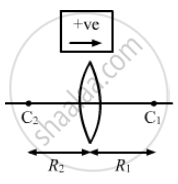
APPEARS IN
संबंधित प्रश्न
Define the power of a lens.
What does sign of power (+ve or –ve) indicate?
What is the focal length of a convex lens of focal length 30 cm in contact with a concave lens of focal length 20 cm? Is the system a converging or a diverging lens? Ignore thickness of the lenses.
Name the physical quantity whose unit is dioptre.
What is the nature of a lens whose power is, −4 D?
An object of height 4 cm is placed at a distance of 15 cm in front of a concave lens of power, −10 dioptres. Find the size of the image.
What is the unit of power of a lens? Define the unit of power of a lens.
A diverging lens has a focal length of 0.10 m. The power of this lens will be:
The power of a lens is +2.0D. Its focal length should be :
On reducing the focal length of a lens, its power ______.
How does focal length of a lens change when red light incident on it is replaced by violet light? Give reason for your answer.
A normal eye is not able to see objects closer than 25 cm because
A double convex lens has two surfaces of equal radii R and refractive index \[m = 1 \cdot 5\]
A symmetric double convex lens is cut in two equal parts by a plane containing the principal axis. If the power of the original lens was 4 D, the power of a divided lens will be
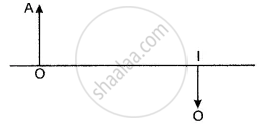
The following diagram shows the object O and the image I formed by a lens. Copy the diagram and on it mark the positions of the lens LL’ and focus (F). Name the lens.
Complete the diagram to show the formation of the image of the object AB.
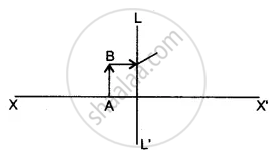
(i) Name the Lens LL’.
(ii) Where is the image of the object AB formed?
(iii) State three characteristics of the image.
A convex lens with radii of curvature R1 = R2 is immersed in water. Assuming that the refractive indices of glass and water are 3/2 and 4/3 respectively, its focal length f1 in comparison to that in air, f, is ______.
An object is kept at a distance of 1m from a lens of power +2D:
- Identify the type of lens.
- Calculate its focal length and distance of the image formed.
A lens has a power of \[+2\,D\]. Its focal length is:
