Advertisements
Advertisements
प्रश्न
A diverging lens has a focal length of 0.10 m. The power of this lens will be:
पर्याय
+10.0D
+1.0D
−1.0D
−10.0D
Advertisements
उत्तर
10.0D,
since power of lens=`1/"focal length"=1/-0.10=-10.0D`
संबंधित प्रश्न
Define 1 dioptre of power of a lens.
The lens mentioned in 6(b) above is of focal length 25cm. Calculate the power of the lens.
How is the power of a lens related to its focal length?
State the condition for the following a lens has both its focal lengths equal .
How does focal length of a lens change when red light incident on it is replaced by violet light? Give reason for your answer.
Consider three converging lenses L1, L2 and L3 having identical geometrical construction. The index of refraction of L1 and L2 are \[\mu_1 \text{ and } \mu_2\] respectively. The upper half of the lens L3 has a refractive index \[\mu_1\] and the lower half has \[\mu_2\] following figure . A point object O is imaged at O1 by the lens L1 and at O2 by the lens L2placed in same position. If L3 is placed at the same place,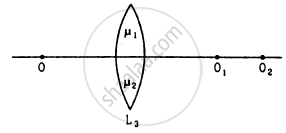
(a) there will be an image at O1
(b) there will be an image at O2.
(c) the only image will form somewhere between O1 and O2
(d) the only image will form away from O2.
A screen is placed a distance 40 cm away from an illuminated object. A converging lens is placed between the source and the screen and its is attempted to form the image of the source on the screen. If no position could be found, the focal length of the lens
A stick partly immersed in water appears to be bent. Draw a ray diagram to show the bending of the stick when placed in water and viewed obliquely from above.
If there is a convex lens of focal length 75 cm and a concave lens of focal length 40 cm, then calculate their combined power and combined focal length.
The power of convex lens of focal length 20 cm is ______.
