Advertisements
Advertisements
प्रश्न
Define power of a lens. Write its units. Deduce the relation `1/f =1/f_1 +1/f_2`for two thin lenses kept in contact coaxially.
Advertisements
उत्तर

Consider two lenses A and B of focal length f1 and f2 placed in contact with each other. An object is placed at a point O beyond the focus of the first lens A. The first lens produces an image at I1 (real image), which serves as a virtual object for the second lens B, producing the final image at I.
Since the lenses are thin, we assume the optical centers (P) of the lenses to be co-incident. For the image formed by the first lens A, we obtain
`1/v_1 -1/u =1/f_1 ........ (1)`
For the image formed by the second lens B, we obtain
`1/v -1/v_1 =1/f_2 ........ (2)`
Adding equations (1) and (2), we obtain
`1/v -1/u =1/f_1 + 1/f_2 ........ (3)`
If the two lens system is regarded as equivalent to a single lens of focal length f, we have
`1/v -1/u =1/f_1 ........ (4)`
From equations (3) and (4), we obtain
`1/f_1 + 1/f_2 =1/f_1 `
संबंधित प्रश्न
Define the power of a lens.
A convex lens forms a real and inverted image of a needle at a distance of 50 cm from it. Where is the needle placed in front of the convex lens if the image is equal to the size of the object? Also, find the power of the lens.
A convex lens of focal length 25 cm and a concave lens of focal length 10 cm are placed in close contact with one another.
(a) What is the power of this combination?
(b) What is the focal length of this combination?
(c) Is this combination converging or diverging?
A symmetric double convex lens in cut in two equal parts by a plane perpendicular to the principal axis. If the power of the original lens was 4 D, the power a cut-lens will be
Which lens has more power a thick lens or a thin lens?
The power of a lens is +2.0 D. Find its focal length and state the kind of lens.
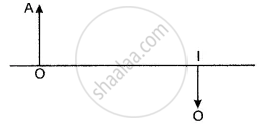
The following diagram shows the object O and the image I formed by a lens. Copy the diagram and on it mark the positions of the lens LL’ and focus (F). Name the lens.
When a lens is placed in a liquid, light refracts at:
A concave lens has:
A lens has a power of \[+2\,D\]. Its focal length is:
