Advertisements
Advertisements
प्रश्न
The power of a combination of two lenses X and Y is 5 D. If the focal length of lens X be 15 cm :
(a) calculate the focal length of lens Y.
(b) state the nature of lens Y.
Advertisements
उत्तर
(a) The focal length of lens X, ie., f1 = 15 cm = 0.15 m
Power of lens X, `p_-1=1/f_1=1/0.15=6.67` D
Let the power and the focal length of the lens Y be P2 and f2, respectively.
The resultant power of the combination of two lenses is the algebraic sum of the powers of the individual lenses.
∴ Power of combination of lenses P = P1 + P2
⇒5 = 6.67 + P2
⇒P2 = 5 - 6.67 = - 1.67 D
The power of the lens is related to the focal length of the lens as:
`p_2=1/f_2`
`-1.67=1/f_2`
`f_2=1/-1.67=0.60`m=-60cm
`f_2=1/-1.67=-0.60m=-60cm`
The focal length of the lens Y is -60 cm.
(b) The focal length of the lens Y is negative. Therefore, the lens is concave and diverging in nature.
APPEARS IN
संबंधित प्रश्न
Kavita from 10th is using spectacles. The power of the lenses in her spectacles is –2.5 dioptre. Answer the following questions:
1) Which lenses are used in her spectacles?
2) State the defect of vision Kavita is suffering from.
3) Find the focal length of the lenses used in her spectacles
What is the power of a convex lens of focal length 0.5 m?
The power of a lens is, −2 D. What is its focal length?
A convex lens of power 5 D and a concave lens of power 7.5 D are placed in contact with each other. What is the :
(a) power of this combination of lenses?
(b) focal length of this combination of lenses?
How does focal length of a lens change when red light incident on it is replaced by violet light? Give reason for your answer.
A 5.0 diopter lens forms a virtual image which is 4 times the object placed perpendicularly on the principal axis of the lens. Find the distance of the object from the lens.
A stick partly immersed in water appears to be bent. Draw a ray diagram to show the bending of the stick when placed in water and viewed obliquely from above.
Complete the diagram to show the formation of the image of the object AB.
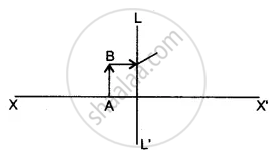
(i) Name the Lens LL’.
(ii) Where is the image of the object AB formed?
(iii) State three characteristics of the image.
Find the power of a convex lens of focal length of + 25 cm.
Assertion and reasoning type
- Assertion: Myopia is due to the increase in the converging power of eye lens.
- Reason: Myopia can be corrected with the help of concave lens.
A convex lens with radii of curvature R1 = R2 is immersed in water. Assuming that the refractive indices of glass and water are 3/2 and 4/3 respectively, its focal length f1 in comparison to that in air, f, is ______.
The focal length of a double convex lens is equal to the radius of curvature of either surface. What is the refractive index of its material?
A convex lens is a converging lens whose focal length and power are both:
When a lens is placed in a liquid, the total power of the lens is:
For a lens immersed in a medium of refractive index \[n_1\], the power is related to the focal length by:
A convex lens has:
The power of a lens of focal length \[f = 0.5\,m\] is:
A lens has a power of \[+2\,D\]. Its focal length is:
