Advertisements
Advertisements
प्रश्न
Fill in the following blank with suitable words :
The reciprocal of the focal length in metres gives you the _________ of the lens, which is measured in ___________.
Advertisements
उत्तर
The reciprocal of the focal length in metres gives you the power of the lens, which is measured in dioptres.
संबंधित प्रश्न
Kavita from 10th is using spectacles. The power of the lenses in her spectacles is –2.5 dioptre. Answer the following questions:
1) Which lenses are used in her spectacles?
2) State the defect of vision Kavita is suffering from.
3) Find the focal length of the lenses used in her spectacles
Which of the two has a greater power: a lens of short focal length or a lens of large focal length?
A converging lens has focal length of 50 mm. What is the power of the lens?
A doctor has prescribed a corrective lens of power, −1.5 D. Find the focal length of the lens. Is the prescribed lens diverging or converging?
A lens has a focal length of, −10 cm. What is the power of the lens and what is its nature?
A convex lens of power 5 D and a concave lens of power 7.5 D are placed in contact with each other. What is the :
(a) power of this combination of lenses?
(b) focal length of this combination of lenses?
What do you understand by the power of a lens?
Define the term focal length of a lens.
How is the power of a lens related to its focal length?
The power of a lens is + 1.0 D is :
Express the power (with sign) of a concave lens of focal length 20 cm.
Define power of a lens. Write its units. Deduce the relation `1/f =1/f_1 +1/f_2`for two thin lenses kept in contact coaxially.
A 5.0 diopter lens forms a virtual image which is 4 times the object placed perpendicularly on the principal axis of the lens. Find the distance of the object from the lens.
Consider the situation described in the previous problem. Where should a point source be placed on the principal axis so that the two images form at the same place?
How is accommodation produced?
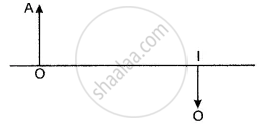
The following diagram shows the object O and the image I formed by a lens. Copy the diagram and on it mark the positions of the lens LL’ and focus (F). Name the lens.
Complete the diagram to show the formation of the image of the object AB.
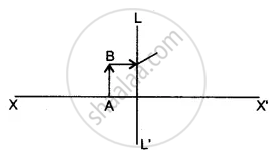
(i) Name the Lens LL’.
(ii) Where is the image of the object AB formed?
(iii) State three characteristics of the image.
If the lens is of focal length 25 cm. Calculate the power of the lens.
According to Rayleigh’s scattering law, the amount of scattering of light is inversely proportional to the fourth power of its ______.
Match the following:
| Column - I | Column - II | ||
| 1 | Retina | a | Path way of light |
| 2 | Pupil | b | Far point comes closer |
| 3 | Ciliary muscles | c | near point moves away |
| 4 | Myopia | d | Screen of the eye |
| 5 | Hypermetropia | e | Power of accommodation |
A convex lens with radii of curvature R1 = R2 is immersed in water. Assuming that the refractive indices of glass and water are 3/2 and 4/3 respectively, its focal length f1 in comparison to that in air, f, is ______.
An object is placed in front of a converging lens. Obtain the conditions under which the magnification produced by the lens is
- negative and
- positive.
A point object is placed at O in front of a glass sphere as shown in figure.

Show the formation of the image by the sphere.
The SI unit of the power of a lens is the:
When a lens is placed in a liquid, the total power of the lens is:
For a lens immersed in a medium of refractive index \[n_1\], the power is related to the focal length by:
