Advertisements
Advertisements
प्रश्न
Consider the situation described in the previous problem. Where should a point source be placed on the principal axis so that the two images form at the same place?
Advertisements
उत्तर
Given,
Convex lens of focal length (fl) = 15 cm
Concave mirror of focal length (fm) = 10 cm
Distance between lens and mirror = 50 cm
Thus, two images will be formed,
(a) One due to direct transmission of light through lens.
(b) One due to reflection and then transmission of the rays through lens.
Let the point source be placed at a distance of 'x' from the lens as shown in the Figure, so that images formed by lens and mirror coincide.
For lens,
We use lens formula:
\[\frac{1}{v} - \frac{1}{u} = \frac{1}{15}\]
\[\Rightarrow v=\frac{15x}{x - 15}...( i)\]
For mirror,
Object distance will be (50 − x)
We use the formula:
\[\frac{1}{v} + \frac{1}{u} = \frac{1}{15}\]
u = − (50 − x)
fm = − 10 cm
\[So, \frac{1}{v_m} + \frac{1}{- (50 - x)} = - \frac{1}{10}\]
\[ \Rightarrow \frac{1}{v_m} = \frac{1}{50 - x} - \frac{1}{10}\]
\[ = \frac{10 - 50 + x}{10(50 - x)}\]
\[ v_m =\frac{x - 40}{10(50 - x)} . . . (ii)\]
Since the distance between lens and mirror is 50 cm,
v − vm = 50
from equation (i) and (ii):
\[\Rightarrow \frac{15x}{x - 15} - \frac{10(50 - x)}{(x - 40)} = 50\]
⇒(3x2 − 120x) − (100x − 2x2 − 1500 + 30x)
= 10 (x2 − 55x + 600)
⇒ 5x2 − 250x − 1500 = 10x2 − 550x + 6000
⇒ 5x2 − 300x + 4500 = 0
⇒ x2 − 60x + 900 = 0
⇒ (x − 30)2 = 0
x = 30 cm.
∴ Point source should be placed at a distance of 30 cm from the lens on the principal axis, so that the two images form at the same place.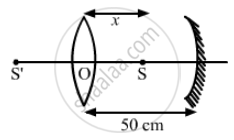
APPEARS IN
संबंधित प्रश्न
What does sign of power (+ve or –ve) indicate?
What can you see in a completely dark room? If you switch on an electric bulb in this dark room as a light source, explain how you could now see:
(a) the electric bulb
(b) a piece of white paper
A converging lens has focal length of 50 mm. What is the power of the lens?
The power of a lens is + 0.2 D. Calculate its focal length.
The optician's prescription for a spectacle lens is marked +0.5 D. What is the:
(a) nature of spectacle lens?
(b) focal length of spectacle lens?
A diverging lens has a focal length of 0.10 m. The power of this lens will be:
How is the sign (+ or -) of power of a lens related to its divergent or convergent action?
Name the type of lens whose power is positive.
The image of an object formed by a lens is real, inverted and of the same size as the object. If the image is at a distance of 40 cm from the lens, what is the nature and power of the lens ? Draw ray diagram to justify your answer.
Mohan obtained a sharp inverted image of a distant tree on the screen placed behind the lens. He then moved the screen and tried to look through the lens in the direction of the object. He would see:
(1) a blurred image on the wall of the laboratory.
(2) an erect image of the tree on the lens.
(3) no image as the screen has been removed
(4) an inverted image of the tree at the focus of the lens.
A double convex lens has focal length 25 cm. The radius of curvature of one of the surfaces is double of the other. Find the radii, if the refractive index of the material of the lens is 1.5.
A convex lens produces a double size real image when an object is placed at a distance of 18 cm from it. Where should the object be placed to produce a triple size real image?
Focal length : metre : : power of lens : _______
The same size images are formed by a convex lens when the object is placed at 20 cm or at 10 cm from the lens. The focal length of convex lens is ______ cm.
When monochromatic red light is used instead of blue light in a convex lens, its focal length will ______.
The SI unit of the power of a lens is the:
A convex lens is a converging lens whose focal length and power are both:
A concave lens is a diverging lens whose focal length and power are both:
For a lens immersed in a medium of refractive index \[n_1\], the power is related to the focal length by:
A lens has a power of \[+2\,D\]. Its focal length is:
