Advertisements
Advertisements
प्रश्न
A converging lens of focal length 15 cm and a converging mirror of focal length 10 cm are placed 50 cm apart with common principal axis. A point source is placed in between the lens and the mirror at a distance of 40 cm from the lens. Find the locations of the two images formed.
Advertisements
उत्तर
Given:
Convex lens of focal length (fl) = 15 cm
Concave mirror of focal length (f2) = 10 cm
Distance between the lens and the mirror = 50 cm
Point source is placed at a distance of 40 cm from the lens.
It means the point source is at the focus of the mirror.
Thus, two images will be formed:
(a) One due to direct transmission of light through the lens.
(b) One due to reflection and then transmission of the rays through the lens.
Case 1:
(S') For the image by direct transmission, we have:
Object distance (u) = − 40 cm
fl = 15 cm
Using the lens formula, we get:
\[\frac{1}{v} - \frac{1}{u} = \frac{1}{f}\]
\[\Rightarrow\frac{1}{v}=\frac{1}{15}+\frac{1}{( - 40)}\]
\[=\frac{40 - 15}{40 \times 15}\]
\[\Rightarrow v=\frac{40 \times 15}{40 - 15}\]
Therefore, v is 24 cm to the left from the lens.
Case II:
(S') Since the object is placed at the focus of the mirror, the rays become parallel to the lens after reflection.
∴ Object distance (u) = ∞ ⇒ fl = 15 cm
\[\Rightarrow \frac{1}{v} - \frac{1}{u} = \frac{1}{15}\]
Thus, v is 15 cm to the left of the lens.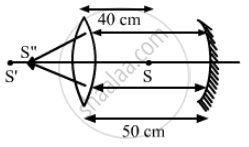
APPEARS IN
संबंधित प्रश्न
What type of wavefront will emerge from a (i) point source, and (ii) distance light source?
A convex lens has a focal length of 10 cm. Find the location and nature of the image if a point object is placed on the principal axis at a distance of (a) 9.8 cm, (b) 10.2 cm from the lens.
A slide projector has to project a 35 mm slide (35 mm × 23 mm) on a 2 m × 2 m screen at a distance of 10 m from the lens. What should be the focal length of the lens in the projector?
A particle executes a simple harmonic motion of amplitude 1.0 cm along the principal axis of a convex lens of focal length 12 cm. The mean position of oscillation is at 20 cm from the lens. Find the amplitude of oscillation of the image of the particle.
An extended object is placed at a distance of 5.0 cm from a convex lens of focal length 8.0 cm. (a) Draw the ray diagram (to the scale) to locate the image and from this, measure the distance of the image from the lens. (b) Find the position of the image from the lens formula and see how close the drawing is to the correct result.
Use the above relation to obtain the condition on the position of the object and the radius of curvature in terms of n1and n2 when the real image is formed.
Define the term ‘focal length of a mirror’.
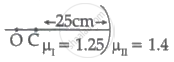
Region I and II are separated by a spherical surface of a radius of 25 cm. An object is kept in the region I at a distance of 40 cm from the surface. The distance of the image from the surface is ______.
A ray of light from a denser medium strikes a rarer medium at an angle of incidence i as shown in the figure. Refracted and reflected rays make an angle of 90° with each other. The angle of reflection and refraction are r and r'. The critical angle is ______.

Assertion: If critical angle of glass-air pair `("μg" = 3/2)` is θ1 and that of water-air pair `("μw" = 4/3)` is θ2, then the critical angle for the water-glass pair will lie between θ1 and θ2.
Reason: A medium is optically denser if its refractive index is greater.
In the Cartesian sign convention, distances measured in the direction of incident light are taken as:
When light goes from a rarer to a denser medium at a spherical surface, the refracted ray:
When light goes from a denser to a rarer medium at a spherical surface, the refracted ray:
In the derivation of the spherical surface refraction formula, which approximation is applied to the angles made by the incident ray, refracted ray, and normal?
In the geometrical setup for refraction at a spherical surface, the centre of curvature, object distance, image distance, and radius of curvature are denoted respectively by:
When a light ray strikes a curved surface and refracts, the amount of bending depends on:
