Advertisements
Advertisements
प्रश्न
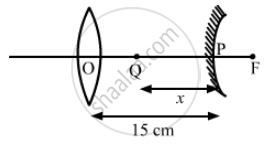
A converging lens and a diverging mirror are placed at a separation of 15 cm. The focal length of the lens is 25 cm and that of the mirror is 40 cm. Where should a point source be placed between the lens and the mirror so that the light, after getting reflected by the mirror and then getting transmitted by the lens, comes out parallel to the principal axis?
Advertisements
उत्तर
Given,
Distance between the convex lens and the convex mirror is 15 cm.
The focal length (f1) of the lens is 25 cm.
The focal length (f2) of the mirror is 40 cm.
Let x cm be the object distance from the mirror.
Therefore,
u = − x cm
v = 25 − 15 = + 10 cm (∵ focal length of lens = 25 cm)
∴ f1 = + 40 cm
Using lens formula:
\[\Rightarrow \frac{1}{v} + \frac{1}{u} = \frac{1}{f}\Rightarrow\frac{1}{x}=\frac{1}{10}-\frac{1}{40}\Rightarrow x=\frac{400}{30} = \frac{40}{3}\]
Thus, the object distance is \[\left( 15 - \frac{40}{3} \right)=\frac{5}{3}\]
= 1.67 cm from the lens
APPEARS IN
संबंधित प्रश्न
A double convex lens is made of a glass of refractive index 1.55, with both faces of the same radius of curvature. Find the radius of curvature required, if the focal length is 20 cm.
Can mirrors give rise to chromatic aberration?
Light is incident from glass (μ = 1.5) to air. Sketch the variation of the angle of deviation δ with the angle of incident i for 0 < i < 90°.
A narrow pencil of parallel light is incident normally on a solid transparent sphere of radius r. What should be the refractive index is the pencil is to be focussed (a) at the surface of the sphere, (b) at the centre of the sphere.
A diverging lens of focal length 20 cm and a converging mirror of focal length 10 cm are placed coaxially at a separation of 5 cm. Where should an object be placed so that a real image is formed at the object itself?
A converging lens of focal length 12 cm and a diverging mirror of focal length 7.5 cm are placed 5.0 cm apart with their principal axes coinciding. Where should an object be placed so that its image falls on itself?
A converging lens of focal length 40 cm is kept in contact with a diverging lens of focal length 30 cm. Find the focal length of the combination .
Two thin lenses having optical powers of -10D and+ 6D are placed in contact with each other. The focal length of the combination is:
State how the focal length of a glass lens (Refractive Index 1.5) changes when it is completely immersed in:
(i) Water (Refractive Index 1.33)
(ii) A liquid (Refractive Index 1.65)
Focal length of a mirror is given by ______.
A parallel beam of light ray parallel to the x-axis is incident on a parabolic reflecting surface x = 2by2 as shown in the figure. After reflecting it passes through focal point F. What is the focal length of the reflecting surface?

An astronomical refractive telescope has an objective of focal length 20 m and an eyepiece of focal length 2 cm.
- The length of the telescope tube is 20.02 m.
- The magnification is 1000.
- The image formed is inverted.
- An objective of a larger aperture will increase the brightness and reduce chromatic aberration of the image.
A short object of length L is placed along the principal axis of a concave mirror away from focus. The object distance is u. If the mirror has a focal length f, what will be the length of the image? You may take L << |v – f|.
A concave mirror of focal length 12 cm forms three times the magnified virtual image of an object. Find the distance of the object from the mirror.
A converging lens has a focal length of 10 cm in air. It is made of a material with a refractive index of 1.6. If it is immersed in a liquid of refractive index 1.3, find its new focal length.
A lens of focal length f is divided into two equal parts and then these parts are put in a combination as shown in the figure below.
- What is the focal length of L1?
- What is the focal length of the final combination?

For a spherical mirror, the normal at the point of incidence is:
Which of the following is a correct statement of one of the laws of reflection?
The laws of reflection are valid:
