Advertisements
Advertisements
प्रश्न
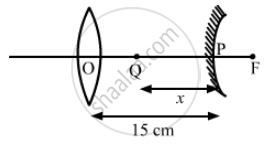
A converging lens and a diverging mirror are placed at a separation of 15 cm. The focal length of the lens is 25 cm and that of the mirror is 40 cm. Where should a point source be placed between the lens and the mirror so that the light, after getting reflected by the mirror and then getting transmitted by the lens, comes out parallel to the principal axis?
Advertisements
उत्तर
Given,
Distance between the convex lens and the convex mirror is 15 cm.
The focal length (f1) of the lens is 25 cm.
The focal length (f2) of the mirror is 40 cm.
Let x cm be the object distance from the mirror.
Therefore,
u = − x cm
v = 25 − 15 = + 10 cm (∵ focal length of lens = 25 cm)
∴ f1 = + 40 cm
Using lens formula:
\[\Rightarrow \frac{1}{v} + \frac{1}{u} = \frac{1}{f}\Rightarrow\frac{1}{x}=\frac{1}{10}-\frac{1}{40}\Rightarrow x=\frac{400}{30} = \frac{40}{3}\]
Thus, the object distance is \[\left( 15 - \frac{40}{3} \right)=\frac{5}{3}\]
= 1.67 cm from the lens
APPEARS IN
संबंधित प्रश्न
A small candle, 2.5 cm in size is placed at 27 cm in front of a concave mirror of radius of curvature 36 cm. At what distance from the mirror should a screen be placed in order to obtain a sharp image? Describe the nature and size of the image. If the candle is moved closer to the mirror, how would the screen have to be moved?
The image of an extended object, placed perpendicular to the principal axis of a mirror, will be erect if
(a) the object and the image are both real
(b) the object and the image are both virtual
(c) the object is real but the image is virtual
(d) the object is virtual but the image is real.
A narrow pencil of parallel light is incident normally on a solid transparent sphere of radius r. What should be the refractive index is the pencil is to be focussed (a) at the surface of the sphere, (b) at the centre of the sphere.
A diverging lens of focal length 20 cm and a converging mirror of focal length 10 cm are placed coaxially at a separation of 5 cm. Where should an object be placed so that a real image is formed at the object itself?
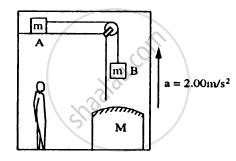
Consider the situation shown in figure. The elevator is going up with an acceleration of 2.00 m s−2 and the focal length of the mirror is 12.0 cm. All the surfaces are smooth and the pulley is light. The mass-pulley system is released from rest (with respect to the elevator) at t = 0 when the distance of B from the mirror is 42.0 cm. Find the distance between the image of the block B and the mirror at t = 0.200 s. Take g = 10 m s−2.
A converging lens of focal length 40 cm is kept in contact with a diverging lens of focal length 30 cm. Find the focal length of the combination .
How can the spherical aberration produced by a lens be minimized?
According to the mirror equation, ______.
You are given four sources of light each one providing a light of a single colour – red, blue, green and yellow. Suppose the angle of refraction for a beam of yellow light corresponding to a particular angle of incidence at the interface of two media is 90°. Which of the following statements is correct if the source of yellow light is replaced with that of other lights without changing the angle of incidence?
The direction of ray of light incident on a concave mirror is shown by PQ while directions in which the ray would travel after reflection is shown by four rays marked 1, 2, 3 and 4 (figure). Which of the four rays correctly shows the direction of reflected ray?

A car is moving with at a constant speed of 60 km h–1 on a straight road. Looking at the rear view mirror, the driver finds that the car following him is at a distance of 100 m and is approaching with a speed of 5 km h–1. In order to keep track of the car in the rear, the driver begins to glance alternatively at the rear and side mirror of his car after every 2 s till the other car overtakes. If the two cars were maintaining their speeds, which of the following statement (s) is/are correct?
If an object is placed at a distance of 10 cm in front of a concave mirror of a focal length of 20 cm, the image formed will be ______.
The geometric centre of a spherical mirror is called its:
Which of the following is a correct statement of one of the laws of reflection?
According to the laws of reflection, the incident ray, the reflected ray, and the normal to the reflecting surface at the point of incidence:
For a curved surface such as a spherical mirror, the normal used in applying the laws of reflection is taken as:
