Advertisements
Advertisements
प्रश्न
The direction of ray of light incident on a concave mirror is shown by PQ while directions in which the ray would travel after reflection is shown by four rays marked 1, 2, 3 and 4 (figure). Which of the four rays correctly shows the direction of reflected ray?

विकल्प
1
2
3
4
Advertisements
उत्तर
2
Explanation:
The ray PQ of light passes through focus F and incident on the concave mirror, after reflection, should become parallel to the principal axis as shown by ray 2 in the figure.
Important points: We can locate the image of any extended object graphically by drawing any two of the following four special rays:
- A ray initially parallel to the principal axis is reflected through the focus of the mirror (1).
- A ray passing through the center of curvature is reflected back along itself (3).
- A ray initially passing through the focus is reflected parallel to the principal axis (2).
- A ray incident at the pole is reflected symmetrically.
APPEARS IN
संबंधित प्रश्न
If an object far away from a convex mirror moves towards the mirror, the image also moves. Does it move faster, slower or at the same speed as compared to the object?
Can mirrors give rise to chromatic aberration?
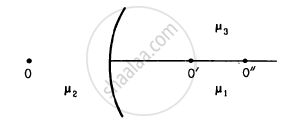
Following figure shows three transparent media of refractive indices \[\mu_1 , \mu_2 \text{ and } \mu_3\]. A point object O is placed in the medium \[\mu_2\]. If the entire medium on the right of the spherical surface has refractive index \[\mu_3\], the image forms at O". In the situation shown,
A diverging lens of focal length 20 cm and a converging mirror of focal length 10 cm are placed coaxially at a separation of 5 cm. Where should an object be placed so that a real image is formed at the object itself?
A converging lens of focal length 12 cm and a diverging mirror of focal length 7.5 cm are placed 5.0 cm apart with their principal axes coinciding. Where should an object be placed so that its image falls on itself?
A converging lens of focal length 40 cm is kept in contact with a diverging lens of focal length 30 cm. Find the focal length of the combination .
How can the spherical aberration produced by a lens be minimized?
Two thin lenses having optical powers of -10D and+ 6D are placed in contact with each other. The focal length of the combination is:
Answer the following question.
Under what conditions is the phenomenon of total internal reflection of light observed? Obtain the relation between the critical angle of incidence and the refractive index of the medium.
According to the mirror equation, ______.
The radius of curvature of the curved surface of a plano-convex lens is 20 cm. If the refractive index of the material of the lens be 1.5, it will ______.
A thin convex lens of focal length 25 cm is cut into two pieces 0.5 cm above the principal axis. The top part is placed at (0, 0) and an object placed at (– 50 cm, 0). Find the coordinates of the image.
A particle is dropped along the axis from a height 15 cm on a concave mirror of focal length 30 cm as shown in figure. The acceleration due to gravity is 10 m/s2. Find the maximum speed of image in m/s:

A concave mirror of focal length 12 cm forms three times the magnified virtual image of an object. Find the distance of the object from the mirror.
Why does a car driver use a convex mirror as a rear-view mirror?
According to the laws of reflection, the incident ray, the reflected ray, and the normal to the reflecting surface at the point of incidence:
The laws of reflection are valid:
For a curved surface such as a spherical mirror, the normal used in applying the laws of reflection is taken as:
