Advertisements
Advertisements
प्रश्न
Light is incident from glass (μ = 1.5) to air. Sketch the variation of the angle of deviation δ with the angle of incident i for 0 < i < 90°.
Advertisements
उत्तर
Given,
Refractive index of glass, μg = 1.5
Refractive index of air, μa= 1.0
Angle of incidence 0° < i < 90
Let us take θc as the Critical angle
\[\Rightarrow \frac{\sin \theta c}{\sin r} = \frac{\mu_a}{\mu_g}\]
\[\Rightarrow \frac{\sin \theta_c}{\sin 90^\circ } = \frac{1}{1 . 5} = 0 . 66\]
\[ \Rightarrow \sin \theta_c = 0 . 66\]
\[ \Rightarrow \theta_c = \sin {}^{- 1} \left( 0 . 66 \right)\]
⇒ θc = 40°48"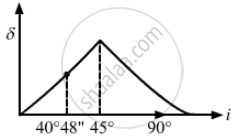
The angle of deviation (δ) due to refraction from glass to air increases as the angle of incidence increases from 0° to 40°48". The angle of deviation (δ) due to total internal reflection further increases from 40°48" to 45° and then it decreases, as shown in the graph.
APPEARS IN
संबंधित प्रश्न
A double convex lens is made of a glass of refractive index 1.55, with both faces of the same radius of curvature. Find the radius of curvature required, if the focal length is 20 cm.
In motor vehicles, a convex mirror is attached near the driver's seat to give him the view of the traffic behind. What is the special function of this convex mirror which a plane mirror can not do?
If an object far away from a convex mirror moves towards the mirror, the image also moves. Does it move faster, slower or at the same speed as compared to the object?
A man uses a concave mirror for shaving. He keeps his face at a distance of 25 cm from the mirror and gets an image which is 1.4 times enlarged. Find the focal length of the mirror.
The image of an extended object, placed perpendicular to the principal axis of a mirror, will be erect if
(a) the object and the image are both real
(b) the object and the image are both virtual
(c) the object is real but the image is virtual
(d) the object is virtual but the image is real.
A narrow pencil of parallel light is incident normally on a solid transparent sphere of radius r. What should be the refractive index is the pencil is to be focussed (a) at the surface of the sphere, (b) at the centre of the sphere.
Consider the situation shown in figure. The elevator is going up with an acceleration of 2.00 m s−2 and the focal length of the mirror is 12.0 cm. All the surfaces are smooth and the pulley is light. The mass-pulley system is released from rest (with respect to the elevator) at t = 0 when the distance of B from the mirror is 42.0 cm. Find the distance between the image of the block B and the mirror at t = 0.200 s. Take g = 10 m s−2.
A converging lens of focal length 40 cm is kept in contact with a diverging lens of focal length 30 cm. Find the focal length of the combination .
With the help of a ray diagram, obtain the relation between its focal length and radius of curvature.
According to the mirror equation, ______.
A thin converging lens of focal length 12 cm is kept in contact with a thin diverging lens of focal length 18 cm. Calculate the effective/equivalent focal length of the combination.
A parallel beam of light ray parallel to the x-axis is incident on a parabolic reflecting surface x = 2by2 as shown in the figure. After reflecting it passes through focal point F. What is the focal length of the reflecting surface?

The radius of curvature of the curved surface of a plano-convex lens is 20 cm. If the refractive index of the material of the lens be 1.5, it will ______.
The direction of ray of light incident on a concave mirror is shown by PQ while directions in which the ray would travel after reflection is shown by four rays marked 1, 2, 3 and 4 (figure). Which of the four rays correctly shows the direction of reflected ray?

A short object of length L is placed along the principal axis of a concave mirror away from focus. The object distance is u. If the mirror has a focal length f, what will be the length of the image? You may take L << |v – f|.
A particle is dropped along the axis from a height 15 cm on a concave mirror of focal length 30 cm as shown in figure. The acceleration due to gravity is 10 m/s2. Find the maximum speed of image in m/s:

The geometric centre of a spherical mirror is called its:
The line joining the pole and the centre of curvature of a spherical mirror is called the:
Which of the following is a correct statement of one of the laws of reflection?
