Advertisements
Advertisements
प्रश्न
With the help of a ray diagram, obtain the relation between its focal length and radius of curvature.
Advertisements
उत्तर १
The distance between the centre of a lens or curved mirror and its focus.
The relationship between the focal length f and the radius of curvature R = 2f.
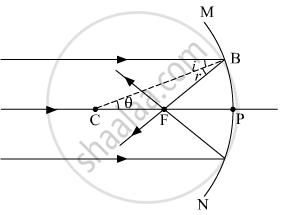
Consider a ray of light AB, parallel to the principal axis and incident on a spherical mirror at point B. The normal to the surface at point B is CB, and CP = CB = R is the radius of curvature. The ray AB, after reflection from a mirror, will pass through F (concave mirror) or will appear to diverge from F (convex mirror) and obeys the law of reflection, i.e., i = r.
From the geometry of the figure,
∠BCP = θ = i
In DCBF, θ = r
∴ BF = FC (because i = r)
If the aperture of the mirror is small, B lies close to P,
∴ BF = PF
Or, FC = FP = PF
Or, PC = PF + FC = PF + PF
Or, R = 2 PF = 2f
Or, f = R/2
A similar relation holds for a convex mirror also. In deriving this relation, we have assumed that the aperture of the mirror is small.
उत्तर २
A ray of light BP' travelling parallel to the principal axis PC is incident on a spherical mirror PP'. It reflects along P'R.
For a concave mirror, it passes through the focus. For a convex mirror, extending the ray backward, it appears to pass through the focus.
P is the pole and Fis the focus of the mirror.
PF = f
C is the centre of curvature.
PC = radius of curvature = R
P'C is the normal to the mirror at the point of incidence P'.
For a concave mirror,
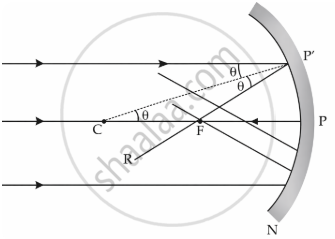
∠BP'C = ∠P'CF = θ ...[alternate angles]
and ∠BP'C = ∠CP'F = θ ...[law of reflection, ∠i = ∠r]
Hence ∠P'CF = ∠CP'F
∴ ΔFP'C is isosceles.
Hence, P'F = FC
If the aperture of the mirror is small, the point P' is very close to the point P, then:
P'F = PF
∴ PF = FC
= `1/2 PC`
∴ f = `1/2 R`
संबंधित प्रश्न
A 4.5 cm needle is placed 12 cm away from a convex mirror of focal length 15 cm. Give the location of the image and the magnification. Describe what happens as the needle is moved farther from the mirror.
A double convex lens is made of a glass of refractive index 1.55, with both faces of the same radius of curvature. Find the radius of curvature required, if the focal length is 20 cm.
In motor vehicles, a convex mirror is attached near the driver's seat to give him the view of the traffic behind. What is the special function of this convex mirror which a plane mirror can not do?
Can mirrors give rise to chromatic aberration?
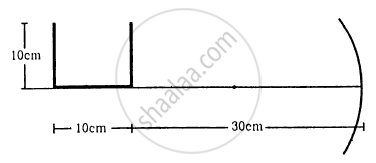
A U-shaped wire is placed before a concave mirror having radius of curvature 20 cm as shown in figure. Find the total length of the image.
A converging lens of focal length 12 cm and a diverging mirror of focal length 7.5 cm are placed 5.0 cm apart with their principal axes coinciding. Where should an object be placed so that its image falls on itself?
A converging lens and a diverging mirror are placed at a separation of 15 cm. The focal length of the lens is 25 cm and that of the mirror is 40 cm. Where should a point source be placed between the lens and the mirror so that the light, after getting reflected by the mirror and then getting transmitted by the lens, comes out parallel to the principal axis?
State how the focal length of a glass lens (Refractive Index 1.5) changes when it is completely immersed in:
(i) Water (Refractive Index 1.33)
(ii) A liquid (Refractive Index 1.65)
A thin convex lens of focal length 25 cm is cut into two pieces 0.5 cm above the principal axis. The top part is placed at (0, 0) and an object placed at (– 50 cm, 0). Find the coordinates of the image.
The angle of incidence is the angle between:
