Advertisements
Advertisements
Question
With the help of a ray diagram, obtain the relation between its focal length and radius of curvature.
Advertisements
Solution 1
The distance between the centre of a lens or curved mirror and its focus.
The relationship between the focal length f and the radius of curvature R = 2f.
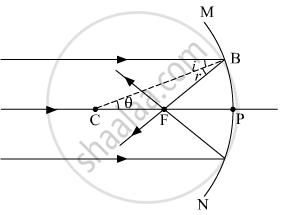
Consider a ray of light AB, parallel to the principal axis and incident on a spherical mirror at point B. The normal to the surface at point B is CB, and CP = CB = R is the radius of curvature. The ray AB, after reflection from a mirror, will pass through F (concave mirror) or will appear to diverge from F (convex mirror) and obeys the law of reflection, i.e., i = r.
From the geometry of the figure,
∠BCP = θ = i
In DCBF, θ = r
∴ BF = FC (because i = r)
If the aperture of the mirror is small, B lies close to P,
∴ BF = PF
Or, FC = FP = PF
Or, PC = PF + FC = PF + PF
Or, R = 2 PF = 2f
Or, f = R/2
A similar relation holds for a convex mirror also. In deriving this relation, we have assumed that the aperture of the mirror is small.
Solution 2
A ray of light BP' travelling parallel to the principal axis PC is incident on a spherical mirror PP'. It reflects along P'R.
For a concave mirror, it passes through the focus. For a convex mirror, extending the ray backward, it appears to pass through the focus.
P is the pole and Fis the focus of the mirror.
PF = f
C is the centre of curvature.
PC = radius of curvature = R
P'C is the normal to the mirror at the point of incidence P'.
For a concave mirror,
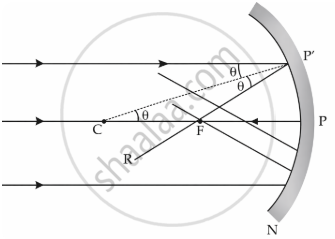
∠BP'C = ∠P'CF = θ ...[alternate angles]
and ∠BP'C = ∠CP'F = θ ...[law of reflection, ∠i = ∠r]
Hence ∠P'CF = ∠CP'F
∴ ΔFP'C is isosceles.
Hence, P'F = FC
If the aperture of the mirror is small, the point P' is very close to the point P, then:
P'F = PF
∴ PF = FC
= `1/2 PC`
∴ f = `1/2 R`
RELATED QUESTIONS
In image formation from spherical mirrors, only paraxial rays are considered because they
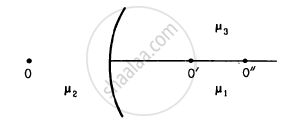
Following figure shows three transparent media of refractive indices \[\mu_1 , \mu_2 \text{ and } \mu_3\]. A point object O is placed in the medium \[\mu_2\]. If the entire medium on the right of the spherical surface has refractive index \[\mu_3\], the image forms at O". In the situation shown,
A converging lens and a diverging mirror are placed at a separation of 15 cm. The focal length of the lens is 25 cm and that of the mirror is 40 cm. Where should a point source be placed between the lens and the mirror so that the light, after getting reflected by the mirror and then getting transmitted by the lens, comes out parallel to the principal axis?
State how the focal length of a glass lens (Refractive Index 1.5) changes when it is completely immersed in:
(i) Water (Refractive Index 1.33)
(ii) A liquid (Refractive Index 1.65)
Answer the following question.
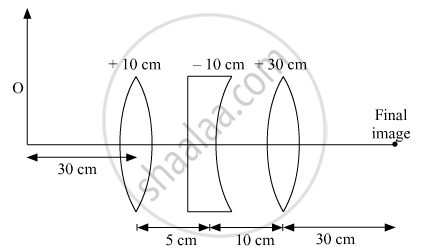
Three lenses of focal length +10 cm, —10 cm and +30 cm are arranged coaxially as in the figure given below. Find the position of the final image formed by the combination.
The radius of curvature of the curved surface of a plano-convex lens is 20 cm. If the refractive index of the material of the lens be 1.5, it will ______.
The direction of ray of light incident on a concave mirror is shown by PQ while directions in which the ray would travel after reflection is shown by four rays marked 1, 2, 3 and 4 (figure). Which of the four rays correctly shows the direction of reflected ray?

A short object of length L is placed along the principal axis of a concave mirror away from focus. The object distance is u. If the mirror has a focal length f, what will be the length of the image? You may take L << |v – f|.
A particle is dropped along the axis from a height 15 cm on a concave mirror of focal length 30 cm as shown in figure. The acceleration due to gravity is 10 m/s2. Find the maximum speed of image in m/s:

The geometric centre of a spherical mirror is called its:
