Advertisements
Advertisements
Question
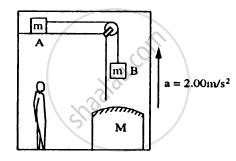
Consider the situation shown in figure. The elevator is going up with an acceleration of 2.00 m s−2 and the focal length of the mirror is 12.0 cm. All the surfaces are smooth and the pulley is light. The mass-pulley system is released from rest (with respect to the elevator) at t = 0 when the distance of B from the mirror is 42.0 cm. Find the distance between the image of the block B and the mirror at t = 0.200 s. Take g = 10 m s−2.
Advertisements
Solution
Given,
Acceleration of the elevator, a = 2.00 m/s2
Focal length of the mirror M, f = 12.00 cm
Acceleration due to gravity, g = 10 m/s2
Mass of blocks A and B = m
As per the question, the mass–pulley system is released at time t = 0.
Let the acceleration of the masses A and B with respect to the elevator be a.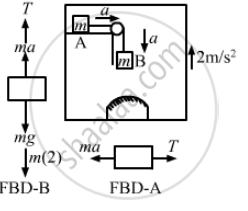
Using the free body diagram,
T − mg + ma − 2m = 0 ...(i)
Also,
T − ma = 0 ...(ii)
From (i) and (ii), we get:
2ma = m(g + 2)
`⇒ a = (10 + 2)/2`
`= 12/2 = 6 ms^-2`
Now, the distance travelled by block B of mass m in time t = 0.2 s is given by
`s = ut + 1/2at^2`
As `(u = 0)`
`s = 1/2 at^2`
On putting the respective values, we get:
`s = 1/2 xx 6 xx (0.2)^2`
`= 0.12 m = 12 cm`
As given in the question, the distance of block B from the mirror is 42 cm.
Object distance u from the mirror = − (42 − 12) = − 30 cm Using the mirror equation,
`1/v + 1/u = 1/f`
On putting the respective values, we get:
`1/v + 1/-30 = 1/12`
⇒ `1/v= 1/-30 = 1/ 12 + 1/30`
⇒ `v = 8.57 cm `
Hence, the distance between block B and mirror M is 8.57 cm.
APPEARS IN
RELATED QUESTIONS
A 4.5 cm needle is placed 12 cm away from a convex mirror of focal length 15 cm. Give the location of the image and the magnification. Describe what happens as the needle is moved farther from the mirror.
In motor vehicles, a convex mirror is attached near the driver's seat to give him the view of the traffic behind. What is the special function of this convex mirror which a plane mirror can not do?
If an object far away from a convex mirror moves towards the mirror, the image also moves. Does it move faster, slower or at the same speed as compared to the object?
In image formation from spherical mirrors, only paraxial rays are considered because they
A diverging lens of focal length 20 cm and a converging mirror of focal length 10 cm are placed coaxially at a separation of 5 cm. Where should an object be placed so that a real image is formed at the object itself?
A converging lens of focal length 40 cm is kept in contact with a diverging lens of focal length 30 cm. Find the focal length of the combination .
With the help of a ray diagram, obtain the relation between its focal length and radius of curvature.
Focal length of a mirror is given by ______.
A thin converging lens of focal length 12 cm is kept in contact with a thin diverging lens of focal length 18 cm. Calculate the effective/equivalent focal length of the combination.
An astronomical refractive telescope has an objective of focal length 20 m and an eyepiece of focal length 2 cm.
- The length of the telescope tube is 20.02 m.
- The magnification is 1000.
- The image formed is inverted.
- An objective of a larger aperture will increase the brightness and reduce chromatic aberration of the image.
A short object of length L is placed along the principal axis of a concave mirror away from focus. The object distance is u. If the mirror has a focal length f, what will be the length of the image? You may take L << |v – f|.
A spherical mirror is obtained as shown in the figure from a hollow glass sphere. if an object is positioned in front of the mirror, what will be the nature and magnification of the image of the object? (Figure drawn as schematic and not to scale)

An object is 20 cm away from a concave mirror and it is within the focal length of the mirror. If the mirror is changed to a plane mirror, the image moves 15 cm closer to the mirror.
Focal length of the concave mirror is ______.
A concave mirror of focal length 12 cm forms three times the magnified virtual image of an object. Find the distance of the object from the mirror.
A converging lens has a focal length of 10 cm in air. It is made of a material with a refractive index of 1.6. If it is immersed in a liquid of refractive index 1.3, find its new focal length.
A lens of focal length f is divided into two equal parts and then these parts are put in a combination as shown in the figure below.
- What is the focal length of L1?
- What is the focal length of the final combination?

The geometric centre of a spherical mirror is called its:
Which of the following is a correct statement of one of the laws of reflection?
The angle of incidence is the angle between:
