Advertisements
Advertisements
प्रश्न
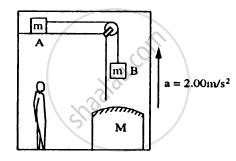
Consider the situation shown in figure. The elevator is going up with an acceleration of 2.00 m s−2 and the focal length of the mirror is 12.0 cm. All the surfaces are smooth and the pulley is light. The mass-pulley system is released from rest (with respect to the elevator) at t = 0 when the distance of B from the mirror is 42.0 cm. Find the distance between the image of the block B and the mirror at t = 0.200 s. Take g = 10 m s−2.
Advertisements
उत्तर
Given,
Acceleration of the elevator, a = 2.00 m/s2
Focal length of the mirror M, f = 12.00 cm
Acceleration due to gravity, g = 10 m/s2
Mass of blocks A and B = m
As per the question, the mass–pulley system is released at time t = 0.
Let the acceleration of the masses A and B with respect to the elevator be a.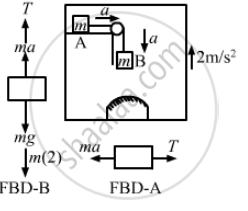
Using the free body diagram,
T − mg + ma − 2m = 0 ...(i)
Also,
T − ma = 0 ...(ii)
From (i) and (ii), we get:
2ma = m(g + 2)
`⇒ a = (10 + 2)/2`
`= 12/2 = 6 ms^-2`
Now, the distance travelled by block B of mass m in time t = 0.2 s is given by
`s = ut + 1/2at^2`
As `(u = 0)`
`s = 1/2 at^2`
On putting the respective values, we get:
`s = 1/2 xx 6 xx (0.2)^2`
`= 0.12 m = 12 cm`
As given in the question, the distance of block B from the mirror is 42 cm.
Object distance u from the mirror = − (42 − 12) = − 30 cm Using the mirror equation,
`1/v + 1/u = 1/f`
On putting the respective values, we get:
`1/v + 1/-30 = 1/12`
⇒ `1/v= 1/-30 = 1/ 12 + 1/30`
⇒ `v = 8.57 cm `
Hence, the distance between block B and mirror M is 8.57 cm.
APPEARS IN
संबंधित प्रश्न
A small candle, 2.5 cm in size is placed at 27 cm in front of a concave mirror of radius of curvature 36 cm. At what distance from the mirror should a screen be placed in order to obtain a sharp image? Describe the nature and size of the image. If the candle is moved closer to the mirror, how would the screen have to be moved?
If an object far away from a convex mirror moves towards the mirror, the image also moves. Does it move faster, slower or at the same speed as compared to the object?
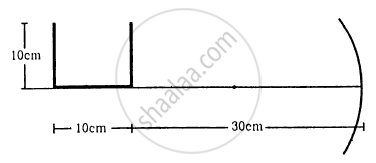
A U-shaped wire is placed before a concave mirror having radius of curvature 20 cm as shown in figure. Find the total length of the image.
Light is incident from glass (μ = 1.5) to air. Sketch the variation of the angle of deviation δ with the angle of incident i for 0 < i < 90°.
A narrow pencil of parallel light is incident normally on a solid transparent sphere of radius r. What should be the refractive index is the pencil is to be focussed (a) at the surface of the sphere, (b) at the centre of the sphere.
Two thin lenses having optical powers of -10D and+ 6D are placed in contact with each other. The focal length of the combination is:
State how the focal length of a glass lens (Refractive Index 1.5) changes when it is completely immersed in:
(i) Water (Refractive Index 1.33)
(ii) A liquid (Refractive Index 1.65)
According to Cartesian sign convention, all distances are measured from the _______.
A parallel beam of light ray parallel to the x-axis is incident on a parabolic reflecting surface x = 2by2 as shown in the figure. After reflecting it passes through focal point F. What is the focal length of the reflecting surface?

The intensity of a point source of light, S, placed at a distance d in front of a screen A, is I0 at the center of the screen. Find the light intensity at the center of the screen if a completely reflecting plane mirror M is placed at a distance d behind the source, as shown in the figure.

A short object of length L is placed along the principal axis of a concave mirror away from focus. The object distance is u. If the mirror has a focal length f, what will be the length of the image? You may take L << |v – f|.
A thin convex lens of focal length 25 cm is cut into two pieces 0.5 cm above the principal axis. The top part is placed at (0, 0) and an object placed at (– 50 cm, 0). Find the coordinates of the image.
A spherical mirror is obtained as shown in the figure from a hollow glass sphere. if an object is positioned in front of the mirror, what will be the nature and magnification of the image of the object? (Figure drawn as schematic and not to scale)

If an object is placed at a distance of 10 cm in front of a concave mirror of a focal length of 20 cm, the image formed will be ______.
According to the laws of reflection, the incident ray, the reflected ray, and the normal to the reflecting surface at the point of incidence:
The laws of reflection are valid:
For a curved surface such as a spherical mirror, the normal used in applying the laws of reflection is taken as:
