Advertisements
Advertisements
प्रश्न
The radius of curvature of the curved surface of a plano-convex lens is 20 cm. If the refractive index of the material of the lens be 1.5, it will ______.
पर्याय
act as a convex lens only for the objects that lie on its curved side.
act as a concave lens for the objects that lie on its curved side.
act as a convex lens irrespective of the side on which the object lies.
act as a concave lens irrespective of side on which the object lies.
Advertisements
उत्तर
The radius of curvature of the curved surface of a plano-convex lens is 20 cm. If the refractive index of the material of the lens be 1.5, it will act as a convex lens irrespective of the side on which the object lies.
Explanation:
If object lies on curved side then R1 = +20 cm and R2 = `oo`, μ1 = 1, μ2 = 1.5
`1/f = (mu_2 - mu_1) (1/R_1 - 1/R_2)`
`1/f = (1.5 - 1) (1/20 - 1/oo) = 0.5/20 = 5/200 = 1/40`
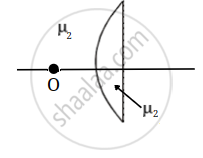
F = + 40 cm
If object lies on plane side R1 = `oo` and R2 = – 20 cm, μ1 = 1, μ2 = 1.5
`1/f = (mu_2 - mu_1) (1/R_1-1/R_2)`
`1/f = (1.5 - 1)(1/oo - (- 1/20)) = 0.5 xx (+ 1/20)`
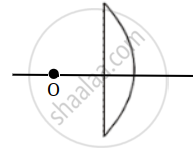
`1/f = 5/200`
f = + 40 cm
So, lens will always act as a convex lens irrespective of the side on which objects lie.
APPEARS IN
संबंधित प्रश्न
A 4.5 cm needle is placed 12 cm away from a convex mirror of focal length 15 cm. Give the location of the image and the magnification. Describe what happens as the needle is moved farther from the mirror.
Can mirrors give rise to chromatic aberration?
A man uses a concave mirror for shaving. He keeps his face at a distance of 25 cm from the mirror and gets an image which is 1.4 times enlarged. Find the focal length of the mirror.
A spherical surface of radius 30 cm separates two transparent media A and B with refractive indices 1.33 and 1.48 respectively. The medium A is on the convex side of the surface. Where should a point object be placed in medium A so that the paraxial rays become parallel after refraction at the surface?
A diverging lens of focal length 20 cm and a converging mirror of focal length 10 cm are placed coaxially at a separation of 5 cm. Where should an object be placed so that a real image is formed at the object itself?
A converging lens of focal length 12 cm and a diverging mirror of focal length 7.5 cm are placed 5.0 cm apart with their principal axes coinciding. Where should an object be placed so that its image falls on itself?
Focal length of a mirror is given by ______.
An astronomical refractive telescope has an objective of focal length 20 m and an eyepiece of focal length 2 cm.
- The length of the telescope tube is 20.02 m.
- The magnification is 1000.
- The image formed is inverted.
- An objective of a larger aperture will increase the brightness and reduce chromatic aberration of the image.
A short object of length L is placed along the principal axis of a concave mirror away from focus. The object distance is u. If the mirror has a focal length f, what will be the length of the image? You may take L << |v – f|.
(i) Consider a thin lens placed between a source (S) and an observer (O) (Figure). Let the thickness of the lens vary as `w(b) = w_0 - b^2/α`, where b is the verticle distance from the pole. `w_0` is a constant. Using Fermat’s principle i.e. the time of transit for a ray between the source and observer is an extremum, find the condition that all paraxial rays starting from the source will converge at a point O on the axis. Find the focal length.

(ii) A gravitational lens may be assumed to have a varying width of the form
`w(b) = k_1ln(k_2/b) b_("min") < b < b_("max")`
= `k_1ln (K_2/b_("min")) b < b_("min")`
Show that an observer will see an image of a point object as a ring about the center of the lens with an angular radius
`β = sqrt((n - 1)k_1 u/v)/(u + v)`
Parallel rays striking a spherical mirror far from the optic axis are focussed at a different point than are rays near the axis thereby the focus moves toward the mirror as the parallel rays move toward the outer edge of the mirror. What value of incidence angle θ produces a 2% change in the location of the focus, compared to the location for θ very close to zero?
A concave mirror of focal length 12 cm forms three times the magnified virtual image of an object. Find the distance of the object from the mirror.
A converging lens has a focal length of 10 cm in air. It is made of a material with a refractive index of 1.6. If it is immersed in a liquid of refractive index 1.3, find its new focal length.
If an object is placed at a distance of 10 cm in front of a concave mirror of a focal length of 20 cm, the image formed will be ______.
The line joining the pole and the centre of curvature of a spherical mirror is called the:
Which of the following is a correct statement of one of the laws of reflection?
According to the laws of reflection, the incident ray, the reflected ray, and the normal to the reflecting surface at the point of incidence:
For a curved surface such as a spherical mirror, the normal used in applying the laws of reflection is taken as:
