Advertisements
Advertisements
प्रश्न
The phenomena involved in the reflection of radiowaves by ionosphere is similar to ______.
पर्याय
reflection of light by a plane mirror.
total internal reflection of light in air during a mirage.
dispersion of light by water molecules during the formation of a rainbow.
scattering of light by the particles of air.
Advertisements
उत्तर
The phenomena involved in the reflection of radiowaves by ionosphere is similar to total internal reflection of light in air during a mirage.
Explanation:
Radio waves are reflected by a layer of the atmosphere called the Ionosphere, so they can reach distant parts of the Earth. The reflection of radio waves by ionosphere is due to total internal reflection. It is the same as total internal reflection of light in the air during a mirage, i.e., angle of incidence is greater than critical angle.
Important point: The ionized part of the Earth’s atmosphere is known as the ionosphere. Ultraviolet light from the sun collides with atoms in this region knocking electrons loose. The creates ions or atoms with missing electrons. This is what gives the Ionosphere its name- and it is the free electrons that cause the reflection and absorption of ratio waves.

APPEARS IN
संबंधित प्रश्न
The diagram below shows a point source P inside a water container. Four rays A, B, C, D starting from the source P, are shown up to the water surface.
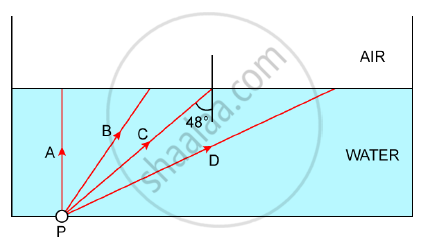
- Show in the diagram the path of these rays after striking the water surface. The Critical Angle for the water-air surface is 48°.
- Name the phenomenon which the rays B and D exhibit.
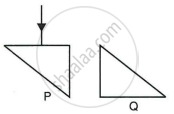
Two isosceles right-angle glass prisms P and Q are placed near each other as shown in Fig. Complete the path of the light ray entering the prism P till it emerges out of the prism Q.
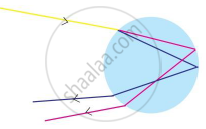
i) Observe the given figure and answer the following questions.
a) Identify and write the natural process shown in the figure.
b) List the phenomena which are observe in this process.
c) Redraw the diagram and show above phenomena in it.
Solve the previous problem if the paperweight is inverted at its place so that the spherical surface touches the paper.
Plot a graph between
Angle of incidence versus angle of refraction.
(a) A ray of monochromatic light enters glass PQRS as shown in the fig. Complete the path of ray till it emerges from the glass. (Critical angle of glass is 420).
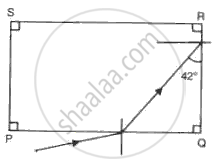
(b) Draw diagram of a prism periscope.
(c) What are the advantages of total internal reflecting prism over plane mirror?
What is meant by the statement, ‘the critical angle for diamond is 24°’?
Explain ‘mirage’ as an illustration of refraction.
Answer the following question.
Define the critical angle of incidence and obtain an expression for it.
Which one of the following is NOT the correct formula for refractive index of glass w.r.t. air (aμg) (i = angle of incidence, r = angle of refraction)
Optical fibre communication uses the principle of ______.
Optical Fibres are based on the phenomenon of dispersion.
What is a mirage? How does it occur?
What is the phenomenon used in optical fiber? Explain.
State the condition under which total internal reflection occurs. Give the mathematical expression for total internal reflection.
Observe the given figure of the raindrop and answer the following questions:
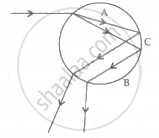
- Label A and B of the given diagram. Why colour will deviate most.
- Name the phenomenon shown in label C.
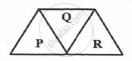
A given ray of light suffers minimum deviation in an equilateral prism P. Additional prism Q and R of identical shape and of the same material as P are now added as shown in the figure. The ray will now suffer ______.
The critical angle is the angle of incidence in the denser medium for which the angle of refraction in the rarer medium is:
