Advertisements
Advertisements
प्रश्न
If a ray of light passes from medium I to medium II without any change of direction, what can be said about the refractive indices of these media (angle I is not 0)?
A ray of light travels from one medium to another medium with no change in direction. If the angle of incidence is not zero, what can be said about the refractive indices of these media?
Advertisements
उत्तर
When a ray of light travels from medium I to medium II without any change of direction, it is possible under either of the following two conditions:
- A ray of light is incident normally on the surface separating two media.
- The refractive index of the medium I is equal to the refractive index of medium II.
APPEARS IN
संबंधित प्रश्न
State the conditions required for total internal reflection of light to take place.
The figure shows a ray of light falling normally on the face AB of an equilateral glass prism having refractive index`3/2`, placed in water of refractive index `4/3`.Will this ray suffer total internal reflection on striking the face AC? Justify your answer.
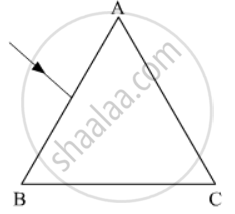
A ray of light is incident on a glass surface at an angle of 50° with the corresponding angle of refraction 30°. Find the value of the R.I. of glass.
A spherical marble, of refractive index 1.5 and curvature 1.5 cm, contains a tiny air bubble at its centre. Where will it appear when seen from outside?
A green light is incident from the water to the air-water interface at the critical angle (C). Select the correct statement.
Total internal reflection can take place only if light is travelling from ______.
The angle of incidence at which the angle of refraction is Q£ is called the critical angle.
When a ray of light is refracted from one medium to another, then the wavelength changes from 6000 Å to 4000 Å. The critical angle for the interface will be ______.
The critical angle is the angle of incidence in the denser medium for which the angle of refraction in the rarer medium is:
If even one of the two required conditions for total internal reflection is missing, then:
