Advertisements
Advertisements
प्रश्न
Name the phenomenon due to which a swimming pool appears less deep than it really is.
Advertisements
उत्तर
This is due to the refraction of light.
संबंधित प्रश्न
If an object is placed at a distance of 10 cm in from of a plane mirror, how far would it be from its image?
Which type of reflection of light leads to the formation of images?
Define the following terms used in the study of reflection of light by drawing a labelled ray-diagram:
- Incident ray
- Point of incidence
- Normal
- Reflected ray
- Angle of incidence
- Angle of reflection
A man stands 10 m in front of a large plane mirror. How far must the walk before he is 5 m away from his image?
A ray of light strikes a plane mirror PQ at an angle of incidence of 30°, is reflected from the plane mirror and then strikes a second plane mirror QR placed at right angles to the first mirror. The angle of reflection at the second mirror is ______.
A ray of light travelling in glass emerges into air. State whether it will bend towards the normal or away from the normal.
A ray of light goes from water into air. Will it bend towards the normal or away from the normal?
When a light ray passes from air into glass, what happens to its speed? Draw a diagram to show which way the ray of light bends.
Light travelling from a denser medium to a rarer medium along a normal to the boundary:
(a) is refracted towards the normal
(b) is refracted away from the normal
(c) goes along the boundary
(d) is not refracted
A vertical ray of light strikes the horizontal surface of some water:
- What is the angle of incidence?
- What is the angle of refraction?
A vertical ray of light strikes the horizontal surface of some water:
What is the angle of refraction?
A ray of light when passes from glass to air, bends towards the normal.
Water is optically .......... than air.
When a ray of light travels from water to air, it bends ............. the normal.
Match the Following
| Column A | Column B |
| (a) white Light | (1) Convex mirror |
| (b) Refraction | (2) Concave mirror |
| (c) Virtual images | (3) refraction |
| (d) Real images | (4) spectrum |
| (e) Prism | (5) ray of light from glass to air |
Draw suitable diagrams to illustrate how a beam of light incident parallel to the principal axis is reflected by:
(a) a concave mirror, and (b) a convex mirror
Choose and write the correct option.
If we gradually increase the angle of incidence of a ray of light passing through prism then …..
The phenomenon of change in the direction of light when it passes from one transparent medium to another is called ___________.
A real image is formed by the light rays after reflection or refraction when they:
- actually meet or intersect with each other.
- actually converge at a point.
- appear to meet when they are produced in the backward direction.
- appear to diverge from a point.
Which of the above statements are correct?
Observe the given figure and name the following.
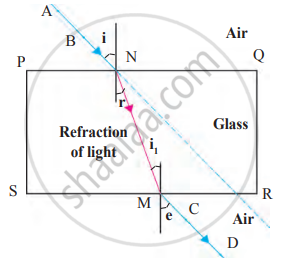
| Ray AB | |
| Ray NM | |
| Ray MD | |
| ∠ r |
Numerical problems.
The speed of light in water is 2.25 × 10⁸ ms–1. If the speed of light in vacuum is 3 × 10⁸ ms–1, calculate the refractive index of water.

The angle of incidence from air to glass at the point O on the hemispherical glass slab is.
Which surface will not reflect most of the light falling on them?
Light travels fastest in a vacuum. Why?
The change in the direction of the path of light when it passes from one transparent medium to another transparent medium is called:
According to the second law of refraction, for a given pair of media, the ratio of the sine of the angle of incidence to the sine of the angle of refraction:
Which of the following relations is called Snell's Law?
