Advertisements
Advertisements
प्रश्न
The phenomenon of change in the direction of light when it passes from one transparent medium to another is called ___________.
पर्याय
dispersion
scattering
Refraction
Reflection
Advertisements
उत्तर
The phenomenon of change in the direction of light when it passes from one transparent medium to another is called Refraction.
APPEARS IN
संबंधित प्रश्न
What is the difference between regular reflection of light and diffuse reflection of light?
The boy walks towards the mirror at a speed of 1 m/s. At what speed does his image approach him?
State and explain the laws of reflection of light at a plane surface (like a plane mirror), With the help of a labelled ray-diagram. Mark the angles of 'incidence' and 'reflection' clearly on the diagram. If the angle of reflection is 47.5°, what will be the angle of incidence?
Explain why, though both a plane mirror and a sheet of paper reflect light but we can see the image of our face in a plane mirror but not in a sheet of paper.
A man stands 10 m in front of a large plane mirror. How far must the walk before he is 5 m away from his image?
If a ray of light goes from a rarer medium to a denser medium, will it bend towards the normal or away from it?
If a ray of light goes form a denser medium to a rarer medium, will it bend towards the normal or away from the normal?
As light rays pass from water into glass, are they refracted towards the normal or away from the normal?
Why does a ray of light bend when it travels from one medium to another?
Light travels more quickly through water than through glass.
If a ray of light passes from glass into water, which way will it bend : towards the normal or away from the normal?
Explain with the help of a labelled ray diagram, why a pencil partly immersed in water appears to be bent at the water surface. State whether the bending of pencil will increase or decrease if water is replaced by another liquid which is optically more dense than water. Give reason for your answer.
Light travelling from a denser medium to a rarer medium along a normal to the boundary:
(a) is refracted towards the normal
(b) is refracted away from the normal
(c) goes along the boundary
(d) is not refracted
How does the light have to enter the glass:
to produce a large amount of bending?
Water is optically denser than glass.
A ray of light when passes from glass to air, bends towards the normal.
The depth of a pond when seen from above appears to be less.
Water is optically .......... than air.
When a ray of light travels from water to air, it bends ............. the normal.
When a ray of light travels from air to glass, it bends .......... the normal.
A light ray suffers reflection and refraction at the boundary in passing from air to water. Draw a neat labelled ray diagram to show it.
What is atmospheric reflection? Explain with the help of a labelled diagram that the position of a star as seen by us is not its true position.
The size of image of an object by a convex lens of focal length 20 cm is observed to be reduced to `1/3` rd of its size . Find the distance of the object from the optical centre of the lens .
Explain how the formation of a rainbow occurs.
The laws of reflection hold true for ______.
Right or wrong sentence.
The incident rays and refracted rays are on opposite sides of the column.
The speed of light varies in different media.
Write scientific reason.
The sun appears on the western horizon for some time after sunset.
Write scientific reason.
The bottom of a pond appears raised.
Observe the given figure and name the following.
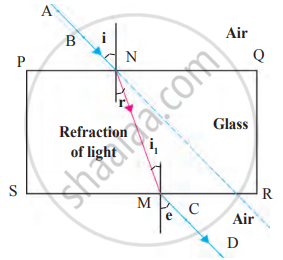
| Ray AB | |
| Ray NM | |
| Ray MD | |
| ∠ r |
Assertion and reasoning type
- Assertion: If the refractive index of the medium is high (denser medium) the velocity of the light in that medium will be small
- Reason: Refractive index of the medium is inversely proportional to the velocity of the light
Which object use the reflection of light?
How does the light travel?
Light bends as it passes from one medium to another. What is this phenomenon called?
The ratio of the sine of the angle of incidence to the sine of ______ is constant.
Mirage is an example of refraction and the total internal reflection of light.
When a light ray passes from a denser medium to a rarer medium, it bends:
In the formula for absolute refractive index \[n = \frac{c}{v}\], the quantity c represents:
