Advertisements
Advertisements
प्रश्न
Why does a ray of light bend when it travels from one medium to another?
Advertisements
उत्तर
The bending of light, when it passes from one medium to another, is known as refraction. It occurs due to the change in the speed of light on going from one medium to another.
APPEARS IN
संबंधित प्रश्न
| Column I | Column II | Column III | |
| 1 | Dispersion | Long-sightedness | Twinkling of stars |
| 2 | Refraction | Splitting of white light into component colours | Convex lens |
| 3 | Hypermetropia | Change in the direction of the ray of light due to change in medium | Spectrum of seven colours |
What is lateral inversion? Explain by giving a suitable example.
What are the important differences between looking at a photograph of your face and looking at yourself in a plane mirror?
Which type of reflection of light leads to the formation of images?
The figure given alongside shows the image of a clock as seen in a plane mirror. The correct time is:
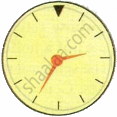
Explain how to read the following message which was found on some blotting paper:

State two effects caused by the refraction of light.
In which material do you think light rays travel faster-glass or air?
State whether the following statement is true or false:
Refraction occurs because light slows down in denser materials.
Show the lateral displacement of the ray on the diagram.
A vertical ray of light strikes the horizontal surface of some water:
What is the angle of refraction?
How does the light have to enter the glass:
to produce a large amount of bending?
Define the principal focus of a concave mirror.
List four characteristics of the image formed by a concave lens of focal length 20 cm when the object is placed at a distance of 40 cm from its optical centre.
A real image is formed by the light rays after reflection or refraction when they:
- actually meet or intersect with each other.
- actually converge at a point.
- appear to meet when they are produced in the backward direction.
- appear to diverge from a point.
Which of the above statements are correct?
The refractive index of four substances A, B, C, and D are 1.31, 1.43, 1.33, 2.4 respectively. The speed of light is maximum in
A pencil when dipped in water in a glass tumbler appears to be bent at the interface of air and water. Will the pencil appear to be bent to the same extent, if instead of water we use liquids like, kerosene or turpentine. Support your answer with reason.
The ratio of the sine of the angle of incidence to the sine of ______ is constant.
Why a pencil partly immersed in water appears to be bent at the water surface.
When light travels from a rarer medium to a denser medium, its speed:
