Advertisements
Advertisements
प्रश्न
Observe the given figure and name the following.
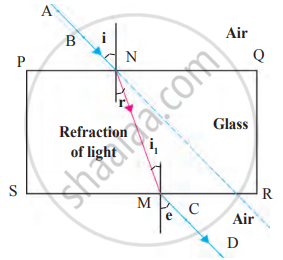
| Ray AB | |
| Ray NM | |
| Ray MD | |
| ∠ r |
Advertisements
उत्तर
| Ray AB | Incident ray |
| Ray NM | Refracted ray |
| Ray MD | Emergent ray |
| ∠ r | Angle of refraction |
संबंधित प्रश्न
Name the phenomenon responsible for the following effect:
When we sit in front of a plane mirror and write with our right hand, it appears in the mirror that we are writing with the left hand.
Which property of light makes a pencil cast a shadow when it is held in front of a light source?
What are the important differences between looking at a photograph of your face and looking at yourself in a plane mirror?
What is the difference between regular reflection of light and diffuse reflection of light?
Define the following terms used in the study of reflection of light by drawing a labelled ray-diagram:
- Incident ray
- Point of incidence
- Normal
- Reflected ray
- Angle of incidence
- Angle of reflection
The image in a plane mirror is virtual and laterally inverted. What does this statement mean?
A ray of light travelling in glass emerges into air. State whether it will bend towards the normal or away from the normal.
A ray of light goes from water into air. Will it bend towards the normal or away from the normal?
State two effects caused by the refraction of light.
State whether the following statement is true or false:
Refraction occurs because light slows down in denser materials.
Why does a ray of light bend when it travels from one medium to another?
Explain with the help of a labelled ray diagram, why a pencil partly immersed in water appears to be bent at the water surface. State whether the bending of pencil will increase or decrease if water is replaced by another liquid which is optically more dense than water. Give reason for your answer.
When a ray of light travelling in glass enters into water obliquely ______.
A vertical ray of light strikes the horizontal surface of some water:
- What is the angle of incidence?
- What is the angle of refraction?
A vertical ray of light strikes the horizontal surface of some water:
What is the angle of refraction?
How does the light have to enter the glass:
for no refraction to happen?
Water is optically .......... than air.
What do you understand by refraction of light?
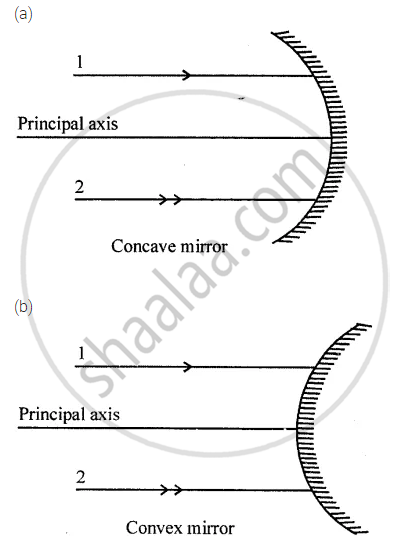
The diagram (figure) given below shows two parallel rays 1 and 2 incident on (a) a concave mirror, (b) a convex mirror. Draw the reflected rays and mark the focus by the symbol F.
Choose and write the correct option.
If we gradually increase the angle of incidence of a ray of light passing through prism then …..
List in proper sequence the steps of the experiment for determining the approximate focal length of a given concave mirror by obtaining the image of a distant object.
The laws of reflection hold true for ______.
Due to _______ pencil looks bent in water, in the given experiment.
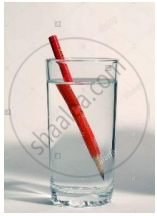
Right or wrong sentence.
The incident rays and refracted rays are on opposite sides of the column.
State whether true or false. If false, correct the statement.
The angle of deviation depends on the refractive index of the glass.
The refractive index of a transparent medium is always greater than ______.
Assertion and reasoning type
- Assertion: If the refractive index of the medium is high (denser medium) the velocity of the light in that medium will be small
- Reason: Refractive index of the medium is inversely proportional to the velocity of the light
The angle of incidence for a ray of light having zero reflection angle is ______.
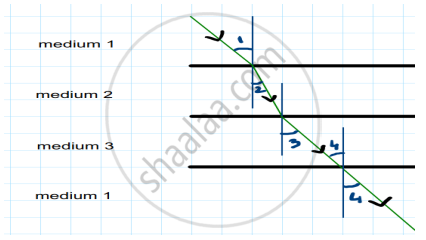
In the above diagram light is travelling through different media. It is noted by a scientist that ∠1= ∠3 = ∠4 but ∠2 < ∠1. Which of the following statement would be correct?
How does the light travel?
A ray of light traveling in medium 1 strikes and travels into another transparent medium 2. If the speed of light is greater in medium 1, the ray will ______.
In refraction of light through a glass slab, the directions of the incident ray and the refracted ray are ______.
When a ray of light travels normal to the given surface, then the angle of refraction is ______.
When light passes from one transparent medium to another, its direction changes due to:
When a light ray passes from a denser medium to a rarer medium, it bends:
According to the first law of refraction, the incident ray, the refracted ray, and the normal at the point of incidence:
