Advertisements
Advertisements
प्रश्न
What is meant by 'reflection of light'?
Advertisements
उत्तर
The process of sending back light rays that fall on the surface of an object is called reflection of light.
संबंधित प्रश्न
If an object is placed at a distance of 10 cm in from of a plane mirror, how far would it be from its image?
Where is the image when you look at something in a mirror?
Which type of reflection of light leads to the formation of images?
What is the difference between regular reflection of light and diffuse reflection of light?
An extended object in the form of an arrow pointing upward has been placed in front of a plane mirror. Draw a labelled ray-diagram to show the formation of its image.
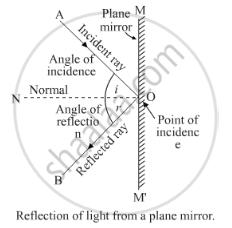
Define the following terms used in the study of reflection of light by drawing a labelled ray-diagram:
- Incident ray
- Point of incidence
- Normal
- Reflected ray
- Angle of incidence
- Angle of reflection
State and explain the laws of reflection of light at a plane surface (like a plane mirror), With the help of a labelled ray-diagram. Mark the angles of 'incidence' and 'reflection' clearly on the diagram. If the angle of reflection is 47.5°, what will be the angle of incidence?
The image in a plane mirror is virtual and laterally inverted. What does this statement mean?
The image formed by a plane mirror is :
(a) virtual, behind the mirror and enlarged.
(b) virtual, behind the mirror and of the same size as the object.
(c) real, at the surface of the mirror and enlarged.
(d) real, behind the mirror and of the same size as the object.
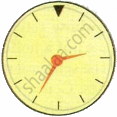
The figure given alongside shows the image of a clock as seen in a plane mirror. The correct time is:
A ray of light strikes a plane mirror PQ at an angle of incidence of 30°, is reflected from the plane mirror and then strikes a second plane mirror QR placed at right angles to the first mirror. The angle of reflection at the second mirror is ______.
If a ray of light goes from a rarer medium to a denser medium, will it bend towards the normal or away from it?
A ray of light travelling in glass emerges into air. State whether it will bend towards the normal or away from the normal.
A ray of light goes from water into air. Will it bend towards the normal or away from the normal?
Why does a ray of light bend when it travels from one medium to another?
Fill in the following blank with suitable word:
Light travelling along a normal is ...............refracted.
What is meant by ‘refraction of light’?
A coin in a glass tumbler appears to rise as the glass tumbler is slowly filled with water. Name the phenomenon responsible for this effect.
- With the help of a diagram, show how when light falls obliquely on the side of a rectangular glass slab, the emergent ray is parallel to the incident ray.
- Show the lateral displacement of the ray on the diagram.
Show the lateral displacement of the ray on the diagram.
State two factors on which the lateral displacement of the emergent ray depends.
A ray of light when passes from glass to air, bends towards the normal.
Light travels at a lower speed in water than in air.
Water is optically .......... than air.
When a ray of light travels from air to glass, it bends .......... the normal.
What do you understand by refraction of light?
Draw a diagram showing the refraction of a light ray from water to glass. Label on it the incident ray, the angle of incidence (/), and the angle of refraction (r)
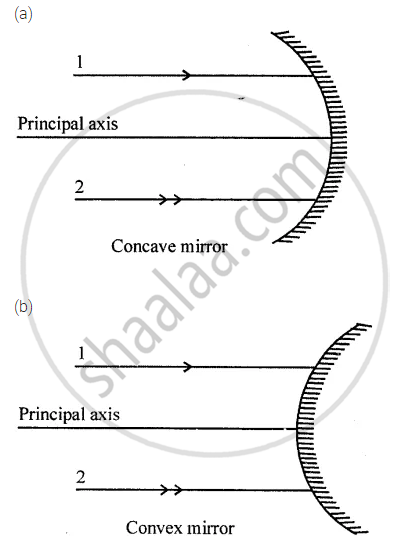
The diagram (figure) given below shows two parallel rays 1 and 2 incident on (a) a concave mirror, (b) a convex mirror. Draw the reflected rays and mark the focus by the symbol F.
A ray of light passes from medium 1 to medium 2. Which of the following quantities of the refracted ray will differ from that of the incident ray: Speed, intensity, frequency, wavelength?
We can see the sun even when it is little below the horizon because of ______.
Define the principal focus of a concave mirror.
What is atmospheric reflection? Explain with the help of a labelled diagram that the position of a star as seen by us is not its true position.
List in proper sequence the steps of the experiment for determining the approximate focal length of a given concave mirror by obtaining the image of a distant object.
Lights of different colours are used as signal for safety transport. From these, the wavelength of red light is _______ nm.
Identify the wrong figure from the following.
Write scientific reason.
The sun appears on the western horizon for some time after sunset.
Observe the given figure and name the following.
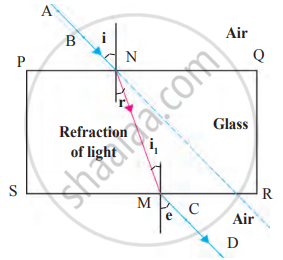
| Ray AB | |
| Ray NM | |
| Ray MD | |
| ∠ r |
Why does a ray of light bend when it travels from one medium to another?
Explain with diagrams how refraction of incident light takes place from
- rarer to denser medium
- denser to rarer medium
- normal to the surface separating the two media.
What is refractive index?
The angle of incidence for a ray of light having zero reflection angle is ______.
Which object use the reflection of light?
When light passes from one medium to another the ray gets bent. This property of light is called ______.
How does the light travel?
A ray of light traveling in medium 1 strikes and travels into another transparent medium 2. If the speed of light is greater in medium 1, the ray will ______.
Twinkling of stars and Mirage are the two phenomena occurring due to refraction.
Under what circumstances there won’t be any refraction of light when it enters from one medium to another?
A ray of light starting from diamond is incident on the interface separating diamond and water. Draw a labelled ray diagram to show. the refraction of light in this case.
When a ray of light travels normal to the given surface, then the angle of refraction is ______.
The part of light that enters into the other medium and travels in a straight path but in a direction different from its initial direction is called:
When a light ray passes from a rarer medium to a denser medium, it bends:
According to the second law of refraction, for a given pair of media, the ratio of the sine of the angle of incidence to the sine of the angle of refraction:
The constant \[\frac{\sin i}{\sin r}\] for a given pair of media is called the:
In the formula for absolute refractive index \[n = \frac{c}{v}\], the quantity c represents:
