Advertisements
Advertisements
प्रश्न
A ray of light travelling in glass emerges into air. State whether it will bend towards the normal or away from the normal.
Advertisements
उत्तर
We know that glass is a denser medium and air is a rarer medium. When a ray of light travels from a denser medium to a rarer medium, it bends away from the normal. So, the ray will bend away from the normal in the given case.
APPEARS IN
संबंधित प्रश्न
If an object is placed at a distance of 10 cm in from of a plane mirror, how far would it be from its image?
What is lateral inversion? Explain by giving a suitable example.
A wall reflects light and a mirror also reflects light. What difference is three in the way they reflect light?
The angle of reflection is equal to the angle of incidence:
(a) always
(b) sometimes
(c) under special conditions
(d) never
A man stands 10 m in front of a large plane mirror. How far must the walk before he is 5 m away from his image?
A ray of light strikes a plane mirror PQ at an angle of incidence of 30°, is reflected from the plane mirror and then strikes a second plane mirror QR placed at right angles to the first mirror. The angle of reflection at the second mirror is ______.
Which phenomenon of light makes the water to appear shallower than it really is?
What is meant by ‘refraction of light’?
Light travels more quickly through water than through glass.
If a ray of light passes from glass into water, which way will it bend : towards the normal or away from the normal?
How does the light have to enter the glass:
to produce a large amount of bending?
A ray of light A incident from air suffers partial reflection and refraction at the boundary of water.
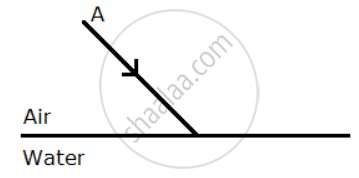
- Complete the diagram showing (i) the reflected ray B and (ii) the refracted ray C.
- How are the angles of incidence i and refraction r related?
A small air bubble in a glass block when seen from above appears to be raised because of ______.
Fill in the blank and Explain the completed sentences.
The change in ______ of light rays while going from one medium to another is called refraction.
A real image is formed by the light rays after reflection or refraction when they:
- actually meet or intersect with each other.
- actually converge at a point.
- appear to meet when they are produced in the backward direction.
- appear to diverge from a point.
Which of the above statements are correct?
State whether true or false. If false, correct the statement.
The angle of deviation depends on the refractive index of the glass.
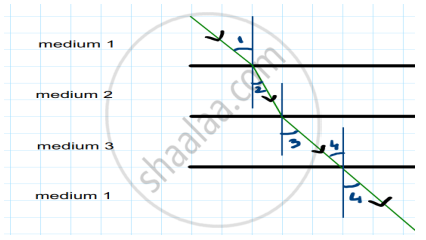
In the above diagram light is travelling through different media. It is noted by a scientist that ∠1= ∠3 = ∠4 but ∠2 < ∠1. Which of the following statement would be correct?
The ratio of the sine of the angle of incidence to the sine of ______ is constant.
Match the following:
| Column I | Column II | ||
| 1. | r > 90 | a. | Light gazes at the surface of separation between the two modes. |
| 2. | r = 90 | b. | No refraction. |
| 3. | r < 90 | c. | Refracted ray away from the normal |
When a light ray passes from a denser medium to a rarer medium, it bends:
In the formula for absolute refractive index \[n = \frac{c}{v}\], the quantity c represents:
