Advertisements
Advertisements
प्रश्न
The angle of reflection is equal to the angle of incidence:
(a) always
(b) sometimes
(c) under special conditions
(d) never
Advertisements
उत्तर
(a) Always, in accordance with the first law of reflection, which states that the angle of reflection is equal to the angle of incidence.
APPEARS IN
संबंधित प्रश्न
What is the difference between regular reflection of light and diffuse reflection of light?
A boy with a mouth 5 cm wide stands 2 m away from a plane mirror. Where is his image and how wide is the image of his mouth?
The boy walks towards the mirror at a speed of 1 m/s. At what speed does his image approach him?
What is meant by 'reflection of light'?
A man stands 10 m in front of a large plane mirror. How far must the walk before he is 5 m away from his image?
Fill in the following blank with suitable word:
Light travelling along a normal is ...............refracted.
A coin in a glass tumbler appears to rise as the glass tumbler is slowly filled with water. Name the phenomenon responsible for this effect.
What is the cause of refraction of light when it passes from one medium to another?
List in proper sequence the steps of the experiment for determining the approximate focal length of a given concave mirror by obtaining the image of a distant object.
The speed of light varies in different media.
Write scientific reason.
The sun appears on the western horizon for some time after sunset.
Observe the given figure and write appropriate phenomenon of light in the box.
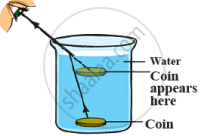
You are given water, mustard oil, glycerine and kerosene. In which of these media a ray of light incident obliquely at same angle would bend the most?
If a beam of red light and a beam of violet light are incident at the same angle on the inclined surface of a prism from air medium and produce angles of refraction r and v respectively, which of the following is correct?
Light travels fastest in a vacuum. Why?
Under what circumstances there won’t be any refraction of light when it enters from one medium to another?
How do twinkling stars occur? (or) what is the cause of the twinkling of stars?
In refraction of light through a glass slab, the directions of the incident ray and the refracted ray are ______.
When a ray of light travels normal to the given surface, then the angle of refraction is ______.
