Advertisements
Advertisements
प्रश्न
Fill in the blank and Explain the completed sentences.
The change in ______ of light rays while going from one medium to another is called refraction.
Advertisements
उत्तर
The change in direction of light rays while going from one medium to another is called refraction.
Explanation:
- Light changes its direction when going from one transparent medium to another transparent medium. This is called the refraction of light.
- As every medium has a different refractive index, this causes the direction of light to change.
APPEARS IN
संबंधित प्रश्न
What is refraction of light?
Where is the image when you look at something in a mirror?
A boy with a mouth 5 cm wide stands 2 m away from a plane mirror. Where is his image and how wide is the image of his mouth?
What is meant by 'reflection of light'?
Define the following terms used in the study of reflection of light by drawing a labelled ray-diagram:
- Incident ray
- Point of incidence
- Normal
- Reflected ray
- Angle of incidence
- Angle of reflection
State and explain the laws of reflection of light at a plane surface (like a plane mirror), With the help of a labelled ray-diagram. Mark the angles of 'incidence' and 'reflection' clearly on the diagram. If the angle of reflection is 47.5°, what will be the angle of incidence?
With the help of a labelled ray-diagram, describe how a plane mirror forms an image of a point source of light placed in front of it. State the characteristics of the image formed in a plane mirror.
The image in a plane mirror is virtual and laterally inverted. What does this statement mean?
The angle of reflection is equal to the angle of incidence:
(a) always
(b) sometimes
(c) under special conditions
(d) never
The image of an object formed by a plane mirror is:
(a) virtual
(b) real
(c) diminished
(d) upside-down
A man sits in an optician's chair looking into plane mirror which is 2 m away from him and views the image of a chart which faces the mirror and is 50 cm behind his head. How far away from his eyes does the chart appear to be?
If a ray of light goes from a rarer medium to a denser medium, will it bend towards the normal or away from it?
A ray of light travelling in glass emerges into air. State whether it will bend towards the normal or away from the normal.
Why does a ray of light bend when it travels from one medium to another?
What is meant by ‘refraction of light’?
When a light ray passes from air into glass, what happens to its speed? Draw a diagram to show which way the ray of light bends.
Name the phenomenon due to which a pencil partly immersed in water and held obliquely appears to be bent at the water surface.
State two factors on which the lateral displacement of the emergent ray depends.
How does the light have to enter the glass:
for no refraction to happen?
Water is optically .......... than air.
Air is optically .......... than glass.
Match the Following
| Column A | Column B |
| (a) white Light | (1) Convex mirror |
| (b) Refraction | (2) Concave mirror |
| (c) Virtual images | (3) refraction |
| (d) Real images | (4) spectrum |
| (e) Prism | (5) ray of light from glass to air |
What do you understand by refraction of light?
Draw a diagram showing the refraction of a light ray from water to glass. Label on it the incident ray, the angle of incidence (/), and the angle of refraction (r)
A ray of light passes from medium 1 to medium 2. Which of the following quantities of the refracted ray will differ from that of the incident ray: Speed, intensity, frequency, wavelength?
A ray of light A incident from air suffers partial reflection and refraction at the boundary of water.
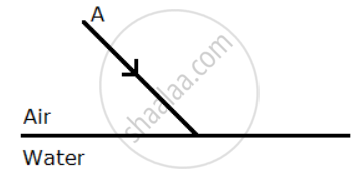
- Complete the diagram showing (i) the reflected ray B and (ii) the refracted ray C.
- How are the angles of incidence i and refraction r related?
Explain how the formation of a rainbow occurs.
Write scientific reason.
The bottom of a pond appears raised.
Why does a ray of light bend when it travels from one medium to another?
Assertion and reasoning type
- Assertion: If the refractive index of the medium is high (denser medium) the velocity of the light in that medium will be small
- Reason: Refractive index of the medium is inversely proportional to the velocity of the light
What is refractive index?
The angle of incidence for a ray of light having zero reflection angle is ______.

The angle of incidence from air to glass at the point O on the hemispherical glass slab is.
When light passes from one medium to another the ray gets bent. This property of light is called ______.
Light bends as it passes from one medium to another. What is this phenomenon called?
Light travels fastest in a vacuum. Why?
Mirage is an example of refraction and the total internal reflection of light.
A ray of light starting from diamond is incident on the interface separating diamond and water. Draw a labelled ray diagram to show. the refraction of light in this case.
