Advertisements
Advertisements
प्रश्न
Prove the statement.
If the angle of incidence and angle of emergence of a light ray falling on a glass slab are i and e respectively, prove that, i = e.
आकृती
Advertisements
उत्तर १
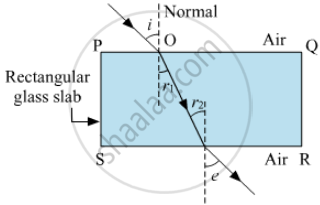
Let \[\mu\] be the refractive index of the glass slab. Then, according to Snell's law,
\[\frac{\sin i}{\sin r_1} = \mu\] .....(i)
and
\[\frac{\sin r_2}{\sin e} = \frac{1}{\mu}\] .....(ii)
But, r1 = r2 .....(iii)
Putting (iii) in (i), we have
Putting (iii) in (i), we have
\[\frac{\sin r_2}{\sin e} = \mu\] .....(iv)
Multiplying (i) and (iv), we have
Multiplying (i) and (iv), we have
\[\frac{\sin i}{\sin e} = 1\]
or
\[i = e\]
or
\[i = e\]
shaalaa.com
उत्तर २
Light is travelling from air to glass.
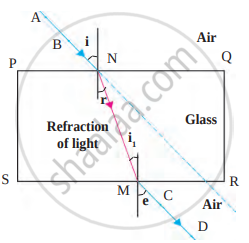
where,
i = Angle of incidence
r = Angle of refraction
e = Angle of emergency
∴ gna = `1/(""_"a""n"_"g")` .....(i)
At surface PQ
gna = `(sin "i")/(sin "r")` .....(ii)
At surface SR
ang = `(sin "r")/(sin "e")` ....(iii)
Substituting (ii) and (iii) in (i)
`(sin "i")/(sin "r") = 1/((sin "r")/(sin "e"))`
∴ `(sin "i")/(sin "r") = (sin "e")/(sin "r")`
∴ sin i = sin e
∴ i = e
shaalaa.com
या प्रश्नात किंवा उत्तरात काही त्रुटी आहे का?
