Advertisements
Advertisements
प्रश्न
The incident rays and refracting rays are on opposite sides of the normal.
पर्याय
Right
Wrong
Advertisements
उत्तर
The incident rays and refracting rays are on opposite sides of the normal- Right
APPEARS IN
संबंधित प्रश्न
What is refraction of light?
| Column I | Column II | Column III | |
| 1 | Dispersion | Long-sightedness | Twinkling of stars |
| 2 | Refraction | Splitting of white light into component colours | Convex lens |
| 3 | Hypermetropia | Change in the direction of the ray of light due to change in medium | Spectrum of seven colours |
Name the phenomenon responsible for the following effect:
When we sit in front of a plane mirror and write with our right hand, it appears in the mirror that we are writing with the left hand.
If an object is placed at a distance of 10 cm in from of a plane mirror, how far would it be from its image?
A boy with a mouth 5 cm wide stands 2 m away from a plane mirror. Where is his image and how wide is the image of his mouth?
State the uses of plane mirrors.
What is meant by 'reflection of light'?
State and explain the laws of reflection of light at a plane surface (like a plane mirror), With the help of a labelled ray-diagram. Mark the angles of 'incidence' and 'reflection' clearly on the diagram. If the angle of reflection is 47.5°, what will be the angle of incidence?
With the help of a labelled ray-diagram, describe how a plane mirror forms an image of a point source of light placed in front of it. State the characteristics of the image formed in a plane mirror.
Explain why, though both a plane mirror and a sheet of paper reflect light but we can see the image of our face in a plane mirror but not in a sheet of paper.
Write all the capital letters of the alphabet which look the same in a plane mirror.
A man stands 10 m in front of a large plane mirror. How far must the walk before he is 5 m away from his image?
Name the phenomenon due to which a swimming pool appears less deep than it really is.
As light rays pass from water into glass, are they refracted towards the normal or away from the normal?
Fill in the following blank with suitable word:
Light travelling along a normal is ...............refracted.
What is meant by ‘refraction of light’?
A coin in a glass tumbler appears to rise as the glass tumbler is slowly filled with water. Name the phenomenon responsible for this effect.
A vertical ray of light strikes the horizontal surface of some water:
What is the angle of refraction?
The speed of light is more in glass than in water.
Draw a diagram showing the refraction of a light ray from water to glass. Label on it the incident ray, the angle of incidence (/), and the angle of refraction (r)
What is the cause of refraction of light when it passes from one medium to another?
Fill in the blank and Explain the completed sentences.
The change in ______ of light rays while going from one medium to another is called refraction.
We can see the sun even when it is little below the horizon because of ______.
A real image is formed by the light rays after reflection or refraction when they:
- actually meet or intersect with each other.
- actually converge at a point.
- appear to meet when they are produced in the backward direction.
- appear to diverge from a point.
Which of the above statements are correct?
Lights of different colours are used as signal for safety transport. From these, the wavelength of red light is _______ nm.
The speed of light varies in different media.
Write scientific reason.
The sun appears on the western horizon for some time after sunset.
Write scientific reason.
The bottom of a pond appears raised.
State whether true or false. If false, correct the statement.
The angle of deviation depends on the refractive index of the glass.
Numerical problems.
The speed of light in water is 2.25 × 10⁸ ms–1. If the speed of light in vacuum is 3 × 10⁸ ms–1, calculate the refractive index of water.
The refractive index of four substances A, B, C, and D are 1.31, 1.43, 1.33, 2.4 respectively. The speed of light is maximum in
You are given water, mustard oil, glycerine and kerosene. In which of these media a ray of light incident obliquely at same angle would bend the most?
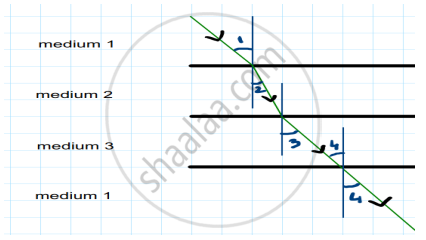
In the above diagram light is travelling through different media. It is noted by a scientist that ∠1= ∠3 = ∠4 but ∠2 < ∠1. Which of the following statement would be correct?
Noor, a young student, was trying to demonstrate some properties of light in her Science project work. She kept ‘X’ inside the box (as shown in the figure) and with the help of a laser pointer made light rays pass through the holes on one side of the box. She had a small butter-paper screen to see the spots of light being cast as they emerged.

Her friend noted the following observations from this demonstration:
- Glass is optically rarer than air.
- Air and glass allow light to pass through them with the same velocity.
- Air is optically rarer than glass.
- Speed of light through a denser medium is faster than that of a rarer medium.
- The ratio: sin of angle of incidence in the first medium to the ratio of sin of angle of refraction in the second medium, gives the refractive index of the second material with respect to the first one.
Which one of the combinations of the above statements given below is correct.
Light bends as it passes from one medium to another. What is this phenomenon called?
Under what circumstances there won’t be any refraction of light when it enters from one medium to another?
Match the following:
| Column I | Column II | ||
| 1. | r > 90 | a. | Light gazes at the surface of separation between the two modes. |
| 2. | r = 90 | b. | No refraction. |
| 3. | r < 90 | c. | Refracted ray away from the normal |
When a ray of light travels normal to the given surface, then the angle of refraction is ______.
