Advertisements
Advertisements
प्रश्न
With the help of a labelled ray-diagram, describe how a plane mirror forms an image of a point source of light placed in front of it. State the characteristics of the image formed in a plane mirror.
Advertisements
उत्तर

Consider a small object (a point source of light), placed in front of a plane mirror MM' (figure 1). The mirror will form an image I of the object O. This process of image formation is explained as follows:
The object O gives out light rays in all directions. Now, a ray of light OA, coming from the object O, is incident on the plane mirror at point A. OA gets reflected in the direction AX in accordance with the law of reflection, which states that the angle of reflection r1 equals the angle of incidence i1. Another ray of light OB, coming from the object O, strikes the mirror at point B. OB gets reflected in the direction BY, thus, making the angle of reflection r2 equal to the angle of incidence i2.
The two reflected rays AX and BY are divergent and cannot meet on the left side. Let's produce the reflected rays AX and BY backwards. They meet at a point I behind the mirror. When the reflected rays AX and BY enter the eye of a person at position E, the eye sees the rays in the direction in which they enter. So, the person looking into the mirror from position E sees the reflected rays as if they are coming from the point I behind the mirror. Thus, the point I is the image of the object O formed by the plane mirror.
The image produced by the plane mirror is virtual, laterally inverse and of the same size as the object.
APPEARS IN
संबंधित प्रश्न
State and explain the laws of reflection of light at a plane surface (like a plane mirror), With the help of a labelled ray-diagram. Mark the angles of 'incidence' and 'reflection' clearly on the diagram. If the angle of reflection is 47.5°, what will be the angle of incidence?
An object is placed 20 cm in front of a plane mirror. The mirror is moved 2 cm towards the object. The distance between the positions of the positions of the original and final images seen in the mirror is ______.
What is meant by ‘refraction of light’?
What is meant by the ‘angle of incidence’ for a ray of light?
How does the light have to enter the glass:
to produce a large amount of bending?
Light enters from air to glass having refractive index 1.50. What is the speed of light in the glass? The speed of light in vacuum is 3 × 10⁸ m s−1.
The phenomenon of change in the direction of light when it passes from one transparent medium to another is called ___________.
Explain with diagrams how refraction of incident light takes place from
- rarer to denser medium
- denser to rarer medium
- normal to the surface separating the two media.
What is refractive index?
The angle of incidence for a ray of light having zero reflection angle is ______.
If a beam of red light and a beam of violet light are incident at the same angle on the inclined surface of a prism from air medium and produce angles of refraction r and v respectively, which of the following is correct?
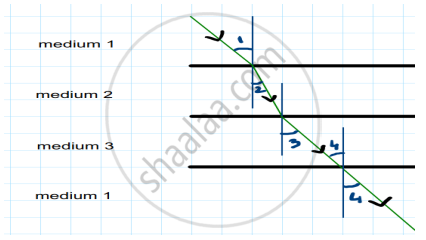
In the above diagram light is travelling through different media. It is noted by a scientist that ∠1= ∠3 = ∠4 but ∠2 < ∠1. Which of the following statement would be correct?
Which object use the reflection of light?
A ray of light traveling in medium 1 strikes and travels into another transparent medium 2. If the speed of light is greater in medium 1, the ray will ______.
Light is refracted or bent while going from one medium to another because of its ______ changes.
A water tank appears shallower when it is viewed from the top due to refraction.
Assertion: The air bubble shines in water.
Reason: Air bubble shines due to the refraction of light.
The ray that enters the second medium after crossing the boundary is called the:
When a light ray passes from a rarer medium to a denser medium, it bends:
According to the second law of refraction, for a given pair of media, the ratio of the sine of the angle of incidence to the sine of the angle of refraction:
