Advertisements
Advertisements
प्रश्न
State and explain the laws of reflection of light at a plane surface (like a plane mirror), With the help of a labelled ray-diagram. Mark the angles of 'incidence' and 'reflection' clearly on the diagram. If the angle of reflection is 47.5°, what will be the angle of incidence?
Advertisements
उत्तर
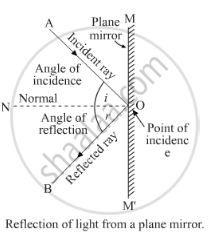
a) The two laws of reflection are:
- The angle of incidence is always equal to the angle of reflection . If the angle of incidence is i and the angle of reflection is r, then, according to the first law of reflection, .`∠i=∠r`
- The second law of reflection states that the incident ray, the reflected ray and the normal (at the point of incidence), all lie in the same plane. For example, in the figure, the incident ray AO, the reflected ray OB and the normal ON, all lie in the same plane.
(b) If the angle of reflection is 47.5°, the angle of incidence will also be 47.5° in accordance with the first law of reflection, which states that the angle of reflection is always equal to the angle of incidence.
APPEARS IN
संबंधित प्रश्न
What are the important differences between looking at a photograph of your face and looking at yourself in a plane mirror?
What type of reflection of light takes place from a cinema screen?
An object is placed 20 cm in front of a plane mirror. The mirror is moved 2 cm towards the object. The distance between the positions of the positions of the original and final images seen in the mirror is ______.
Explain how to read the following message which was found on some blotting paper:

State two effects caused by the refraction of light.
What is meant by ‘refraction of light’?
When a light ray passes from air into glass, what happens to its speed? Draw a diagram to show which way the ray of light bends.
- With the help of a diagram, show how when light falls obliquely on the side of a rectangular glass slab, the emergent ray is parallel to the incident ray.
- Show the lateral displacement of the ray on the diagram.
The speed of light is more in glass than in water.
Match the Following
| Column A | Column B |
| (a) white Light | (1) Convex mirror |
| (b) Refraction | (2) Concave mirror |
| (c) Virtual images | (3) refraction |
| (d) Real images | (4) spectrum |
| (e) Prism | (5) ray of light from glass to air |
Draw a diagram showing the refraction of a light ray from water to glass. Label on it the incident ray, the angle of incidence (/), and the angle of refraction (r)
A ray of light passes from medium 1 to medium 2. Which of the following quantities of the refracted ray will differ from that of the incident ray: Speed, intensity, frequency, wavelength?
A small air bubble in a glass block when seen from above appears to be raised because of ______.
We can see the sun even when it is little below the horizon because of ______.
Define the principal focus of a concave mirror.
Why does a ray of light bend when it travels from one medium to another?
A star appears twinkling into the sky because of the reflection of light by the atmosphere.
Under what circumstances there won’t be any refraction of light when it enters from one medium to another?
