Advertisements
Advertisements
प्रश्न
State and explain the laws of reflection of light at a plane surface (like a plane mirror), With the help of a labelled ray-diagram. Mark the angles of 'incidence' and 'reflection' clearly on the diagram. If the angle of reflection is 47.5°, what will be the angle of incidence?
Advertisements
उत्तर
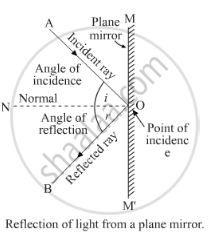
a) The two laws of reflection are:
- The angle of incidence is always equal to the angle of reflection . If the angle of incidence is i and the angle of reflection is r, then, according to the first law of reflection, .`∠i=∠r`
- The second law of reflection states that the incident ray, the reflected ray and the normal (at the point of incidence), all lie in the same plane. For example, in the figure, the incident ray AO, the reflected ray OB and the normal ON, all lie in the same plane.
(b) If the angle of reflection is 47.5°, the angle of incidence will also be 47.5° in accordance with the first law of reflection, which states that the angle of reflection is always equal to the angle of incidence.
APPEARS IN
संबंधित प्रश्न
Name the phenomenon responsible for the following effect:
When we sit in front of a plane mirror and write with our right hand, it appears in the mirror that we are writing with the left hand.
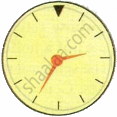
The figure given alongside shows the image of a clock as seen in a plane mirror. The correct time is:
A man sits in an optician's chair looking into plane mirror which is 2 m away from him and views the image of a chart which faces the mirror and is 50 cm behind his head. How far away from his eyes does the chart appear to be?
Explain how to read the following message which was found on some blotting paper:

If a ray of light goes form a denser medium to a rarer medium, will it bend towards the normal or away from the normal?
Which phenomenon of light makes the water to appear shallower than it really is?
Show the lateral displacement of the ray on the diagram.
When a ray of light travelling in glass enters into water obliquely ______.
How does the light have to enter the glass:
to produce a large amount of bending?
Water is optically denser than glass.
When a ray of light travels from air to glass, it bends .......... the normal.
Lights of different colours are used as signal for safety transport. From these, the wavelength of red light is _______ nm.
The speed of light varies in different media.
Assertion and reasoning type
- Assertion: If the refractive index of the medium is high (denser medium) the velocity of the light in that medium will be small
- Reason: Refractive index of the medium is inversely proportional to the velocity of the light
If a beam of red light and a beam of violet light are incident at the same angle on the inclined surface of a prism from air medium and produce angles of refraction r and v respectively, which of the following is correct?
Light is refracted or bent while going from one medium to another because of its ______ changes.
Mirage is an example of refraction and the total internal reflection of light.
Match the following:
| Column I | Column II | ||
| 1. | r > 90 | a. | Light gazes at the surface of separation between the two modes. |
| 2. | r = 90 | b. | No refraction. |
| 3. | r < 90 | c. | Refracted ray away from the normal |
When a ray of light travels normal to the given surface, then the angle of refraction is ______.
According to the first law of refraction, the incident ray, the refracted ray, and the normal at the point of incidence:
