English

State and Explain the Laws of Reflection of Light at a Plane Surface (Like a Plane Mirror), with the Help of a Labelled Ray-diagram. Mark the Angles of 'Incidence' and 'Reflection' Clearly on the D - Science

Advertisements
Advertisements

Question

State and explain the laws of reflection of light at a plane surface (like a plane mirror), With the help of a labelled ray-diagram. Mark the angles of 'incidence' and 'reflection' clearly on the diagram. If the angle of reflection is 47.5°, what will be the angle of incidence?

Advertisements

Solution
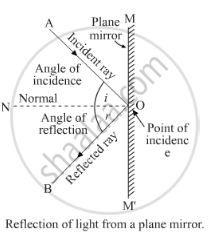
  

a) The two laws of reflection are:

  1. The angle of incidence is always equal to the angle of reflection . If the angle of incidence is i and the angle of reflection is r, then, according to the first law of reflection,   .`∠i=∠r`
For example, if one measures the angle of reflection
  1. The second law of reflection states that the incident ray, the reflected ray and the normal (at the point of incidence), all lie in the same plane. For example, in the figure, the incident ray AO, the reflected ray OB and the normal ON, all lie in the same plane.

(b) If the angle of reflection is 47.5°, the angle of incidence will also be 47.5° in accordance with the first law of reflection, which states that the angle of reflection is always equal to the angle of incidence.

shaalaa.com
  Is there an error in this question or solution?
Chapter 4: Reflection of Light - Exercise 1 [Page 174]

APPEARS IN

Lakhmir Singh Physics (Science) [English] Class 10
Chapter 4 Reflection of Light
Exercise 1 | Q 27 | Page 174

RELATED QUESTIONS

A ray of light strikes a plane mirror such that its angle of incidence is 30°. What angle does the reflected ray make with the mirror surface?


With the help of a labelled ray-diagram, describe how a plane mirror forms an image of a point source of light placed in front of it. State the characteristics of the image formed in a plane mirror.


The angle of reflection is equal to the angle of incidence:

(a) always
(b) sometimes
(c) under special conditions
(d) never


If a ray of light goes from a rarer medium to a denser medium, will it bend towards the normal or away from it?


Why does a ray of light bend when it travels from one medium to another?


Fill in the following blank with suitable word:  

Light bends when is passes from water into air. We say that it is ............


Light travels more quickly through water than through glass. 

If a ray of light passes from glass into water, which way will it bend : towards the normal or away from the normal?


When a light ray passes from air into glass, what happens to its speed? Draw a diagram to show which way the ray of light bends. 


 Name the phenomenon due to which a pencil partly immersed in water and held obliquely appears to be bent at the water surface.


List in proper sequence the steps of the experiment for determining the approximate focal length of a given concave mirror by obtaining the image of a distant object.


The phenomenon of change in the direction of light when it passes from one transparent medium to another is called ___________.


The speed of light varies in different media.


Observe the given figure and write appropriate phenomenon of light in the box.


Assertion and reasoning type

  1. Assertion: If the refractive index of the medium is high (denser medium) the velocity of the light in that medium will be small
  2. Reason: Refractive index of the medium is inversely proportional to the velocity of the light

What is refractive index?


Twinkling of stars and Mirage are the two phenomena occurring due to refraction.


Which is optically denser out of the two medium M1& M2 having the refractive indices = 1.71 and 1.36 respectively?


How do twinkling stars occur? (or) what is the cause of the twinkling of stars?


When a ray of light travels normal to the given surface, then the angle of refraction is ______.


Share
Notifications

Englishहिंदीमराठी


      Forgot password?
Use app×