Advertisements
Advertisements
प्रश्न
With the help of a labelled ray-diagram, describe how a plane mirror forms an image of a point source of light placed in front of it. State the characteristics of the image formed in a plane mirror.
Advertisements
उत्तर

Consider a small object (a point source of light), placed in front of a plane mirror MM' (figure 1). The mirror will form an image I of the object O. This process of image formation is explained as follows:
The object O gives out light rays in all directions. Now, a ray of light OA, coming from the object O, is incident on the plane mirror at point A. OA gets reflected in the direction AX in accordance with the law of reflection, which states that the angle of reflection r1 equals the angle of incidence i1. Another ray of light OB, coming from the object O, strikes the mirror at point B. OB gets reflected in the direction BY, thus, making the angle of reflection r2 equal to the angle of incidence i2.
The two reflected rays AX and BY are divergent and cannot meet on the left side. Let's produce the reflected rays AX and BY backwards. They meet at a point I behind the mirror. When the reflected rays AX and BY enter the eye of a person at position E, the eye sees the rays in the direction in which they enter. So, the person looking into the mirror from position E sees the reflected rays as if they are coming from the point I behind the mirror. Thus, the point I is the image of the object O formed by the plane mirror.
The image produced by the plane mirror is virtual, laterally inverse and of the same size as the object.
APPEARS IN
संबंधित प्रश्न
What is lateral inversion? Explain by giving a suitable example.
What is the difference between regular reflection of light and diffuse reflection of light?
Fill in the following blank with suitable word:
Light travelling along a normal is ...............refracted.
State two factors on which the lateral displacement of the emergent ray depends.
Water is optically denser than glass.
Choose and write the correct option.
If we gradually increase the angle of incidence of a ray of light passing through prism then …..
The size of image of an object by a convex lens of focal length 20 cm is observed to be reduced to `1/3` rd of its size . Find the distance of the object from the optical centre of the lens .
Write scientific reason.
The bottom of a pond appears raised.
Write scientific reason.
A pencil appears to be broken near the surface of water.
The refractive index of four substances A, B, C, and D are 1.31, 1.43, 1.33, 2.4 respectively. The speed of light is maximum in
Assertion and reasoning type
- Assertion: If the refractive index of the medium is high (denser medium) the velocity of the light in that medium will be small
- Reason: Refractive index of the medium is inversely proportional to the velocity of the light
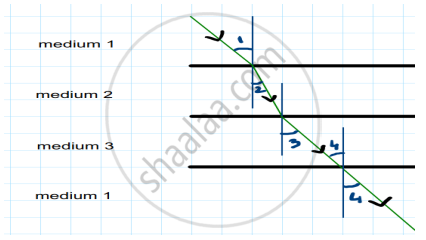
In the above diagram light is travelling through different media. It is noted by a scientist that ∠1= ∠3 = ∠4 but ∠2 < ∠1. Which of the following statement would be correct?
How does the light travel?
The bottom of swimming pool appears to be less deep than the actual one because of
When a ray of light is incident along the normal on the surface separating two media:
According to the first law of refraction, the incident ray, the refracted ray, and the normal at the point of incidence:
According to the second law of refraction, for a given pair of media, the ratio of the sine of the angle of incidence to the sine of the angle of refraction:
The absolute refractive index of a medium is given by:
