Advertisements
Advertisements
प्रश्न
The incident rays and refracting rays are on opposite sides of the normal.
विकल्प
Right
Wrong
Advertisements
उत्तर
The incident rays and refracting rays are on opposite sides of the normal- Right
APPEARS IN
संबंधित प्रश्न
What is refraction of light?
State whether the following statement is true of false:
A student says that we can see an object because light from our eyes is reflected back by the object.
What type of reflection of light takes place from a cinema screen?
State and explain the laws of reflection of light at a plane surface (like a plane mirror), With the help of a labelled ray-diagram. Mark the angles of 'incidence' and 'reflection' clearly on the diagram. If the angle of reflection is 47.5°, what will be the angle of incidence?
The image formed by a plane mirror is :
(a) virtual, behind the mirror and enlarged.
(b) virtual, behind the mirror and of the same size as the object.
(c) real, at the surface of the mirror and enlarged.
(d) real, behind the mirror and of the same size as the object.
A man stands 10 m in front of a large plane mirror. How far must the walk before he is 5 m away from his image?
State two effects caused by the refraction of light.
State whether the following statement is true or false:
Refraction occurs because light slows down in denser materials.
Why does a ray of light bend when it travels from one medium to another?
What is meant by the ‘angle of incidence’ for a ray of light?
Light travelling from a denser medium to a rarer medium along a normal to the boundary:
(a) is refracted towards the normal
(b) is refracted away from the normal
(c) goes along the boundary
(d) is not refracted
A ray of light passes from a medium X to another medium Y. No refraction of light occurs if the ray of light hits the boundary of medium Y at an angle of:
(a) 0°
(b) 45°
(c) 90°
(d) 120°
Water is optically denser than glass.
A ray of light when passes from glass to air, bends towards the normal.
Light travels at a lower speed in water than in air.
A ray of light A incident from air suffers partial reflection and refraction at the boundary of water.
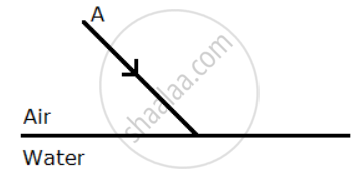
- Complete the diagram showing (i) the reflected ray B and (ii) the refracted ray C.
- How are the angles of incidence i and refraction r related?
The size of image of an object by a convex lens of focal length 20 cm is observed to be reduced to `1/3` rd of its size . Find the distance of the object from the optical centre of the lens .
The laws of reflection hold true for ______.
Lights of different colours are used as signal for safety transport. From these, the wavelength of red light is _______ nm.
Light changes its direction when going from one transparent medium to another transparent medium. This is called _______.
Observe the given figure and name the following.
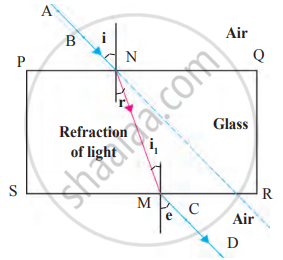
| Ray AB | |
| Ray NM | |
| Ray MD | |
| ∠ r |
Explain with diagrams how refraction of incident light takes place from
- rarer to denser medium
- denser to rarer medium
- normal to the surface separating the two media.
Numerical problems.
The speed of light in water is 2.25 × 10⁸ ms–1. If the speed of light in vacuum is 3 × 10⁸ ms–1, calculate the refractive index of water.
Assertion and reasoning type
- Assertion: If the refractive index of the medium is high (denser medium) the velocity of the light in that medium will be small
- Reason: Refractive index of the medium is inversely proportional to the velocity of the light

The angle of incidence from air to glass at the point O on the hemispherical glass slab is.
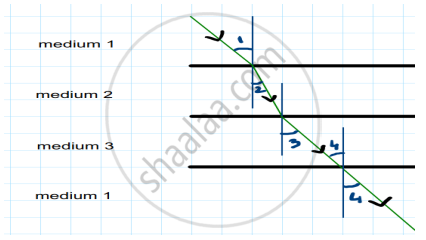
In the above diagram light is travelling through different media. It is noted by a scientist that ∠1= ∠3 = ∠4 but ∠2 < ∠1. Which of the following statement would be correct?
A pencil when dipped in water in a glass tumbler appears to be bent at the interface of air and water. Will the pencil appear to be bent to the same extent, if instead of water we use liquids like, kerosene or turpentine. Support your answer with reason.
Which object use the reflection of light?
The phenomenon of light passing through the object is called ______.
When light passes from one medium to another the ray gets bent. This property of light is called ______.
Which is optically denser out of the two medium M1& M2 having the refractive indices = 1.71 and 1.36 respectively?
Under what circumstances there won’t be any refraction of light when it enters from one medium to another?
Match the following:
| Column I | Column II | ||
| 1. | r > 90 | a. | Light gazes at the surface of separation between the two modes. |
| 2. | r = 90 | b. | No refraction. |
| 3. | r < 90 | c. | Refracted ray away from the normal |
When a ray of light travels normal to the given surface, then the angle of refraction is ______.
