Advertisements
Advertisements
प्रश्न
Numerical problems.
The speed of light in water is 2.25 × 10⁸ ms–1. If the speed of light in vacuum is 3 × 10⁸ ms–1, calculate the refractive index of water.
Advertisements
उत्तर
Given: Speed of light in water (υ) = 2.25 × 10⁸ms– 1
Speed of light in vacuum (c) = 3 × 10⁸ms– 1
Solution:
μ = `"c"/"υ"` ⇒ μ =`(3×10^8"ms"^(−1))/(2.25×10^8"ms"^(−1))`
∴ μ = 1.33
APPEARS IN
संबंधित प्रश्न
A man sits in an optician's chair looking into plane mirror which is 2 m away from him and views the image of a chart which faces the mirror and is 50 cm behind his head. How far away from his eyes does the chart appear to be?
A ray of light travelling in air is incident on a rectangular glass block and emerges out into the air from the opposite face. Draw a labelled ray diagram to show the completer path of this ray of light. Mark the two points where the refraction of light takes place. What can you say about the final direction of ray of light?
Light travels more quickly through water than through glass.
If a ray of light passes from glass into water, which way will it bend : towards the normal or away from the normal?
A coin in a glass tumbler appears to rise as the glass tumbler is slowly filled with water. Name the phenomenon responsible for this effect.
A vertical ray of light strikes the horizontal surface of some water:
What is the angle of refraction?
What do you understand by refraction of light?
What is the cause of refraction of light when it passes from one medium to another?
Define the principal focus of a concave mirror.
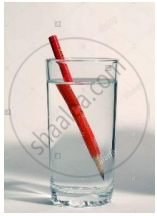
Due to _______ pencil looks bent in water, in the given experiment.
The part of light that enters into the other medium and travels in a straight path but in a direction different from its initial direction is called:
