Advertisements
Advertisements
प्रश्न
Choose and write the correct option.
If we gradually increase the angle of incidence of a ray of light passing through prism then …..
विकल्प
Angle of deviation goes on decreasing.
Angle of deviation decreases but after certain value of incident angle, deviation angle increases
Angle of deviation goes on increasing.
Angle of deviation increases but after certain value of incident angle deviation angle decreases.
Advertisements
उत्तर
Angle of deviation decreases but after certain value of
incident angle, deviation angle increases.
APPEARS IN
संबंधित प्रश्न
Which property of light makes a pencil cast a shadow when it is held in front of a light source?
A ray of light strikes a plane mirror such that its angle of incidence is 30°. What angle does the reflected ray make with the mirror surface?
What is lateral inversion? Explain by giving a suitable example.
Write the word AMBULANCE as it would appear when reflected in a plane mirror. Why is it sometimes written in this way (as its mirror image) on the front of an ambulance?
What are the important differences between looking at a photograph of your face and looking at yourself in a plane mirror?
The boy walks towards the mirror at a speed of 1 m/s. At what speed does his image approach him?
Explain why, though both a plane mirror and a sheet of paper reflect light but we can see the image of our face in a plane mirror but not in a sheet of paper.
The image in a plane mirror is virtual and laterally inverted. What does this statement mean?
In which material do you think light rays travel faster-glass or air?
Which phenomenon of light makes the water to appear shallower than it really is?
Why does a ray of light bend when it travels from one medium to another?
Fill in the following blank with suitable word:
Light bends when is passes from water into air. We say that it is ............
What is meant by the ‘angle of incidence’ for a ray of light?
Light travels more quickly through water than through glass.
If a ray of light passes from glass into water, which way will it bend : towards the normal or away from the normal?
Explain with the help of a labelled ray diagram, why a pencil partly immersed in water appears to be bent at the water surface. State whether the bending of pencil will increase or decrease if water is replaced by another liquid which is optically more dense than water. Give reason for your answer.
How does the light have to enter the glass:
for no refraction to happen?
The depth of a pond when seen from above appears to be less.
What do you understand by refraction of light?
A ray of light passes from medium 1 to medium 2. Which of the following quantities of the refracted ray will differ from that of the incident ray: Speed, intensity, frequency, wavelength?
Define the principal focus of a concave mirror.
Light enters from air to glass having refractive index 1.50. What is the speed of light in the glass? The speed of light in vacuum is 3 × 10⁸ m s−1.
Observe the given figure and name the following.
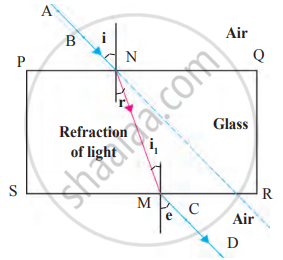
| Ray AB | |
| Ray NM | |
| Ray MD | |
| ∠ r |
Why does a ray of light bend when it travels from one medium to another?
Numerical problems.
The speed of light in water is 2.25 × 10⁸ ms–1. If the speed of light in vacuum is 3 × 10⁸ ms–1, calculate the refractive index of water.
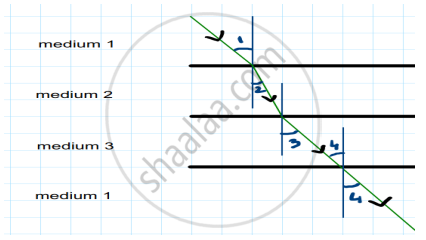
In the above diagram light is travelling through different media. It is noted by a scientist that ∠1= ∠3 = ∠4 but ∠2 < ∠1. Which of the following statement would be correct?
Which surface will not reflect most of the light falling on them?
A ray of light traveling in medium 1 strikes and travels into another transparent medium 2. If the speed of light is greater in medium 1, the ray will ______.
A water tank appears shallower when it is viewed from the top due to refraction.
Twinkling of stars and Mirage are the two phenomena occurring due to refraction.
Assertion: The air bubble shines in water.
Reason: Air bubble shines due to the refraction of light.
Match the following:
| Column I | Column II | ||
| 1. | r > 90 | a. | Light gazes at the surface of separation between the two modes. |
| 2. | r = 90 | b. | No refraction. |
| 3. | r < 90 | c. | Refracted ray away from the normal |
A ray of light starting from diamond is incident on the interface separating diamond and water. Draw a labelled ray diagram to show. the refraction of light in this case.
The part of light that enters into the other medium and travels in a straight path but in a direction different from its initial direction is called:
When light travels from a denser medium to a rarer medium, its speed:
According to the first law of refraction, the incident ray, the refracted ray, and the normal at the point of incidence:
To a crane, a fish appears 6 cm below the water surface. Taking the refractive index of water as \[\frac{4}{3}\], the real depth of the fish below the surface is:
