Advertisements
Advertisements
Question
Choose and write the correct option.
If we gradually increase the angle of incidence of a ray of light passing through prism then …..
Options
Angle of deviation goes on decreasing.
Angle of deviation decreases but after certain value of incident angle, deviation angle increases
Angle of deviation goes on increasing.
Angle of deviation increases but after certain value of incident angle deviation angle decreases.
Advertisements
Solution
Angle of deviation decreases but after certain value of
incident angle, deviation angle increases.
APPEARS IN
RELATED QUESTIONS
What is refraction of light?
Which property of light makes a pencil cast a shadow when it is held in front of a light source?
Write the word AMBULANCE as it would appear when reflected in a plane mirror. Why is it sometimes written in this way (as its mirror image) on the front of an ambulance?
A wall reflects light and a mirror also reflects light. What difference is three in the way they reflect light?
Which type of reflection of light leads to the formation of images?
What is meant by 'reflection of light'?
Explain why, though both a plane mirror and a sheet of paper reflect light but we can see the image of our face in a plane mirror but not in a sheet of paper.
The figure given alongside shows the image of a clock as seen in a plane mirror. The correct time is:
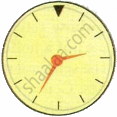
An object is placed 20 cm in front of a plane mirror. The mirror is moved 2 cm towards the object. The distance between the positions of the positions of the original and final images seen in the mirror is ______.
A ray of light passes from air into a block of glass. Does it bend towards the normal or away from it?
In which material do you think light rays travel faster-glass or air?
State whether the following statement is true or false:
Refraction occurs because light slows down in denser materials.
The depth of a pond when seen from above appears to be less.
Match the Following
| Column A | Column B |
| (a) white Light | (1) Convex mirror |
| (b) Refraction | (2) Concave mirror |
| (c) Virtual images | (3) refraction |
| (d) Real images | (4) spectrum |
| (e) Prism | (5) ray of light from glass to air |
What is the cause of refraction of light when it passes from one medium to another?
Fill in the blank and Explain the completed sentences.
The change in ______ of light rays while going from one medium to another is called refraction.
What is atmospheric reflection? Explain with the help of a labelled diagram that the position of a star as seen by us is not its true position.
List four characteristics of the image formed by a concave lens of focal length 20 cm when the object is placed at a distance of 40 cm from its optical centre.
Lights of different colours are used as signal for safety transport. From these, the wavelength of red light is _______ nm.
Identify the wrong figure from the following.
State whether true or false. If false, correct the statement.
The angle of deviation depends on the refractive index of the glass.
Numerical problems.
The speed of light in water is 2.25 × 10⁸ ms–1. If the speed of light in vacuum is 3 × 10⁸ ms–1, calculate the refractive index of water.
The angle of incidence for a ray of light having zero reflection angle is ______.
If a beam of red light and a beam of violet light are incident at the same angle on the inclined surface of a prism from air medium and produce angles of refraction r and v respectively, which of the following is correct?
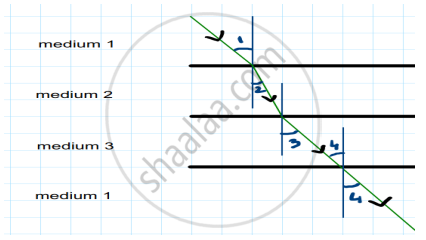
In the above diagram light is travelling through different media. It is noted by a scientist that ∠1= ∠3 = ∠4 but ∠2 < ∠1. Which of the following statement would be correct?
Noor, a young student, was trying to demonstrate some properties of light in her Science project work. She kept ‘X’ inside the box (as shown in the figure) and with the help of a laser pointer made light rays pass through the holes on one side of the box. She had a small butter-paper screen to see the spots of light being cast as they emerged.

Her friend noted the following observations from this demonstration:
- Glass is optically rarer than air.
- Air and glass allow light to pass through them with the same velocity.
- Air is optically rarer than glass.
- Speed of light through a denser medium is faster than that of a rarer medium.
- The ratio: sin of angle of incidence in the first medium to the ratio of sin of angle of refraction in the second medium, gives the refractive index of the second material with respect to the first one.
Which one of the combinations of the above statements given below is correct.
The phenomenon of light passing through the object is called ______.
When light passes from one medium to another the ray gets bent. This property of light is called ______.
The bending of light as it passes from one medium to another is called ______.
A star appears twinkling into the sky because of the reflection of light by the atmosphere.
A water tank appears shallower when it is viewed from the top due to refraction.
How do twinkling stars occur? (or) what is the cause of the twinkling of stars?
The part of light that enters into the other medium and travels in a straight path but in a direction different from its initial direction is called:
The ray that enters the second medium after crossing the boundary is called the:
The constant \[\frac{\sin i}{\sin r}\] for a given pair of media is called the:
Which of the following relations is called Snell's Law?
A larger refractive index of a medium means that light travels:
