Advertisements
Advertisements
Question
Yesh find out F1 and F2 of symmetric convex lens experimentally then which conclusion is true.
Options
a) 𝐹1 = 𝐹2
b) 𝐹1 > 𝐹2
c) 𝐹1 < 𝐹2
d) 𝐹1 ≠ 𝐹2
Advertisements
Solution
a) 𝐹1 = 𝐹2
APPEARS IN
RELATED QUESTIONS
Draw a ray diagram to show the formation of image in the above situation
A student places a candle flame at a distance of about 60 cm from a convex lens of focal length 10 cm and focuses the image of the flame on a screen. After that he gradually moves the flame towards the lens and each time focuses the image on the screen.
(a) In which direction-toward or away from the lens, does he move the screen to focus the image?
(b) How does the size of the image change?
(c) How does the intensity of the image change as the flame moves towards the lens?
(d) Approximately for what distance between the flame and the lens, the image formed on the screen is inverted and of the same size?
Study the given ray diagrams and select the correct statement from the following:
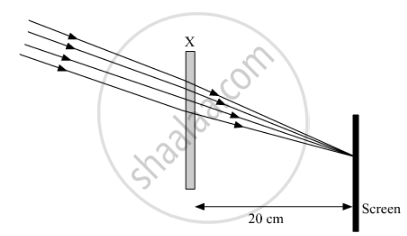
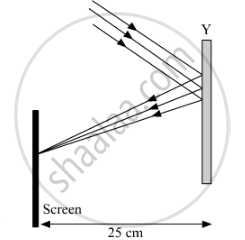
(A) Device X is a concave mirror and device Y is a convex lens, whose focal lengths are 20 cm and 25 cm respectively.
(B) Device X is a convex lens and device Y is a concave mirror, whose focal lengths are 10 cm and 25 cm respectively.
(C) Device X is a concave lens and device Y is a convex mirror, whose focal lengths are 20 cm and 25 cm respectively.
(D) Device X is a convex lens and device Y is a concave mirror, whose focal lengths are 20 cm and 25 cm respectively.
Write one condition where it does not bend when entering a medium of different optical density.
Draw a labelled ray diagram to show how a ray of light is refracted when it passes:
from an optically denser medium into air.
How could you find the focal length of a convex lens rapidly but approximately?
List some things that convex lens and concave mirror have in common.
An object 4 cm high is placed at a distance of 10 cm from a convex lens of focal length 20 cm. Find the position, nature and size of the image.
What kind of lens can form:
an inverted magnified image?
What type of lens is used to correct
hypermetropia
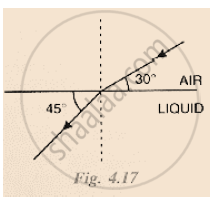
The diagram alongside shows the refraction of a ray of light from sir to a liquid.
(a) write the values of (i) angle of incidence, (ii) angle of refraction.
(b) use snell’s law to find the refractive index of liquid with respect to air.
The focal length of a thin convex lens is ______ than that of a thick convex lens.
Where is the image formed?
In the following cases, where must an object be placed in front of a convex lens so that the image formed is inverted and enlarged?
A convex lens has a divergent action and a concave lens has a convergent action.
State two applications of a convex lens.
(a) What type of a lens can be used as a magnifying glass?
(b) Show by a ray diagram the formation of a real image by simple magnifying lens.
State the position of object, position of image, nature of image when: Convex lens is used in cine projector.
Draw a diagram to show the convergent action of a convex lens by treating it as a combination of glass block and two triangular glass prisms, with the aid of two parallel incident rays.
Distinguish between:
Concave lens and Convex Lens
