Advertisements
Advertisements
प्रश्न
Yesh find out F1 and F2 of symmetric convex lens experimentally then which conclusion is true.
पर्याय
a) 𝐹1 = 𝐹2
b) 𝐹1 > 𝐹2
c) 𝐹1 < 𝐹2
d) 𝐹1 ≠ 𝐹2
Advertisements
उत्तर
a) 𝐹1 = 𝐹2
APPEARS IN
संबंधित प्रश्न
An object is placed at a distance of 12 cm from a convex lens of focal length 8 cm. Find :
1) the position of the image
2) nature of the image
Explain with the help of a diagram, why the convex lens is also called a converging lens.
Describe the nature of image formed when an object is placed at a distance of 30 cm from a convex lens of focal length 15 cm.
Find the nature, position and magnification of the images formed by a convex lens of focal length 0.20 m if the object is placed at a distance of:
0.15 m
Complete the following sentence.
A long-sighted person cannot see ........... objects clearly. Long-sightedness can be corrected by using .............. lenses.
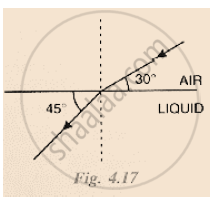
The diagram alongside shows the refraction of a ray of light from sir to a liquid.
(a) write the values of (i) angle of incidence, (ii) angle of refraction.
(b) use snell’s law to find the refractive index of liquid with respect to air.
Show by a diagram the refraction of two light rays incident parallel to the principal axis on a convex lens by treating it as a combination of a glass slab and two triangular glass prisms.
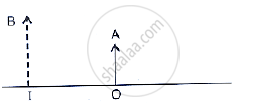
The given below figure shows an object OA and its image IB formed by a lens. State three characteristics of the image.
To find the image distance for varying object distances in case of a convex lens of focal length 15 cm, a student obtains on a screen a sharp image of a bright object by placing it at 20 cm distance from the lens. After that he gradually moves the object away from the lens and each time focuses the image on the screen.
(a) In which direction-towards or away from the lens does he move the screen to focus the object?
(b) How does the size of image change?
(c) Approximately at what distance does he obtain the image of magnification –1?
(d) How does the intensity of image change as the object moves farther and farther away from the lens?
The image obtained while finding the focal length of convex lens is ....................
Observe the following figure and complete the table:

| Points | Answer |
| (i) Position of the object | |
| (ii) Position of the image | |
| (iii) Size of the image | |
| (iv) Nature of the image |
A concave mirror and convex lens are held in water. What changes, if any, do you expect in their focal length?
Draw a diagram to show the convergent action of a convex lens by treating it as a combination of glass block and two triangular glass prisms, with the aid of two parallel incident rays.
Define the terms principal foci and focal lengths as applied to a convex lens, and show them with the help of proper diagrams.
Can one bum a piece of paper in daylight by just using a convex lens instead of a match or any direct flame? Support your answer with the help of an appropriate ray diagram.
_______ is a combination of two convex lenses with small focal length.
Find the odd one out and give its explanation.
Find the odd one out and give its explanation.
A convex lens of focal length 20 cm can produce a magnified virtual as well as real image. Is this a correct statement? If yes, where shall the object be placed in each case for obtaining these images?
Distinguish between Concave lens and Convex Lens.
