Advertisements
Advertisements
प्रश्न
Find the odd one out and give its explanation.
पर्याय
Simple microscope
Compound microscope
Telescope
Prism
Advertisements
उत्तर
Prism
Explanation-
Prism disperses light while other optical instruments produce magnified images of objects.
APPEARS IN
संबंधित प्रश्न
(a) Draw a ray diagram to show the formation of image by a concave lens when an object is placed in front of it.
(b) In the above diagram mark the object distance (u) and the image distance (v) with their proper signs (+ve or –ve as per the new Cartesian sign convention) and state how these distances are related to the focal length (f) of the concave lens in the case.
(c) Find the nature and power of a lens which forms a real and inverted image of magnification –1 at a distance of 40 cm from the optical centre.
A beam of light travelling in a rectangular glass slab emerges into air. Draw a ray-diagram indicating the change in its path.
Draw a labelled ray diagram to show the angle of incidence and the angle of refraction for a refracted ray of light.
List some things that convex lens and concave mirror have in common.
Calculate the focal length of a convex lens which produces a virtual image at a distance of 50 cm of an object placed 20 cm in front of it.
Find the nature, position and magnification of the images formed by a convex lens of focal length 0.20 m if the object is placed at a distance of:
0.50 m
A beam of parallel light rays is incident through the holes on one side of a box and emerges out through the holes on its opposite side as shown in the diagram below:
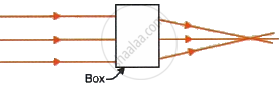
Which of the following could be inside the box?
What would be the diameter of the image of the flower on the film?
The focal lengths of four convex lenses P, Q, R and S are 20 cm, 15 cm, 5 cm and 10 cm, respectively. The lens having the greatest power is:
In a certain murder investigation, it was important to discover whether the victim was long-sighted or short-sighted. How could a detective decide by examining his spectacles?
In the following cases, where must an object be placed in front of a convex lens so that the image formed is of the same size as the object?
Analyse the following observation table showing variation of image-distance (v) with object-distance (u) in case of a convex lens and answer the questions that follow without doing any calculations:
| S. No. | Object-Distance u (cm) |
Image-Distance v (cm) |
| 1 | –60 | +12 |
| 2 | –30 | +15 |
| 3 | –20 | +20 |
| 4 | –15 | +30 |
| 5 | –12 | +60 |
| 6 | –9 | +90 |
(a) What is the focal length of the convex lens? State reason for your answer.
(b) For what object-distance (u) is the corresponding image-distance (v) not correct? How did you arrive at this conclusion?
(c) Choose an appropriate scale to draw a ray diagram for the observation at S. No. 4 and find the approximate value of magnification.
A student focussed the image of a distant object using a device ‘X’ on a white screen ‘S’ as shown in the figure. If the distance of the screen from the device is 40 cm, select the correct statement about the device.
(A) The device X is a convex lens of focal length 20 cm.
(B) The device X is a concave mirror of focal length 40 cm.
(C) The device X is a convex mirror of radius of curvature 40 cm.
(D) The device X is a convex lens of focal length 40 cm.
An object is placed perpendicular to the principal axis of a convex lens of focal length 20 cm. The distance of the object from the lens is 30 cm. Find (i) the position (ii) the magnification and (iii) the nature of the image formed.
The image obtained while finding the focal length of convex lens is ....................
(a) What type of a lens can be used as a magnifying glass?
(b) Show by a ray diagram the formation of a real image by simple magnifying lens.
A pin 2 cm long is placed 12 cm away from a convex lens at right angles to the principal axis. If the focal length of the lens is 20 cm, by scale drawing find the size of the image and its magnification.
State the position of object, position of image, nature of image when: Convex lens is used as objective lens of astronomical telescope.
For a specific glass lens f = 0.5 m. This is the only information given to the student. Which type of lens is given to him and what is its power?
A beam of light is incident through the holes on side A and emerges out of the holes on the other face of the box as show in the figure. Which of the following could be inside the box?

