Advertisements
Advertisements
प्रश्न
The image obtained while finding the focal length of convex lens is ....................
पर्याय
a) a real and erect.
b) virtual and erect.
c) real and inverted.
d) virtual and inverted.
Advertisements
उत्तर
c) real and inverted.
APPEARS IN
संबंधित प्रश्न
An object 5 cm is placed at a distance of 20 cm in front of a convex mirror of radius of curvature 30 cm. Find the position, nature and size of the image.
An object of height 4.0 cm is placed at a distance of 30 cm from the optical centre 'O' of a convex lens of focal length 20 cm. Draw a ray diagram to find the position and size of the image formed. Mark optical centre 'O' and principal focus 'F' on the diagram. Also find the approximate ratio of size of the image to the size of the object.
Draw a labelled ray diagram to show how a ray of light is refracted when it passes:
from an optically denser medium into air.
If an object is at a considerable distance (or infinity) in front of a convex lens, where is the image formed?
Parallel rays of light are refracted by a convex lens to a point called the ______.
You eye contains a convex lens. Why is it unwise to look at the sun?
In order to obtain a real image twice the size of the object with a convex lens of focal length 15 cm, the object distance should be:
(a) more than 5 cm but less than 10 cm
(b) more than 10 cm but less than 15 cm
(c) more than 15 cm but less than 30 cm
(d) more than 30 cm but less than 60 cm
An object 2 cm tall is placed on the axis of a convex lens of focal length 5 cm at a distance of 10 m from the optical centre of the lens. Find the nature, position and size of the image formed. Which case of image formation by convex lenses is illustrated by this example?
Which of the above two cases illustrates the working of a magnifying glass?
Find the nature, position and magnification of the images formed by a convex lens of focal length 0.20 m if the object is placed at a distance of:
0.15 m
A parallel oblique beam of light falls on a convex lens. Draw a diagram to show the refraction of light through the lens.
Out of the five incident rays shown in the figure find the three rays that are obeying the laws of refraction and may be used for locating the position of image formed by a convex lens:
(A) 1, 2 and 3
(B) 2, 3 and 4
(C) 3, 4 and 5
(D) 1, 2 and 4
For finding the focal length of a convex lens by obtaining the image of a distant object, one should use as the object.
(1) a well lit distant tree
(2) window grill in the class room
(3) any distant tree
(4) a lighted candle kept at the other end of the table.
Where should an object be placed in front of a convex lens to get a real image of the size of the object?
A convex lens forms an inverted image of size same as that of the object which is placed at a distance 60 cm in front of the lens. Find: The position of image
Draw a ray diagram to illustrate the determination of the focal length of a convex lens using an auxiliary plane mirror.
Diagram shows an object AB placed on the principal axis B of a convex lens placed in air. F1 and F2 are the two foci of the lens.
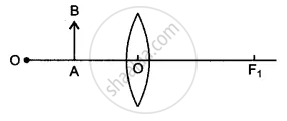
(i) Copy the diagram:
Draw a ray of light starting from B and passing through O. Show the same ray after refraction by the lens. Draw another ray from B which passes through F2 after refraction by the lens. Locate the final image
(ii) Is the image real or virtual?
Define the terms principal foci and focal lengths as applied to a convex lens, and show them with the help of proper diagrams.
- In which type of microscope do you find the lens arrangement as shown in the following diagram?

- Write about the working and the use of this microscope.
Distinguish between Concave lens and Convex Lens.
