Advertisements
Advertisements
प्रश्न
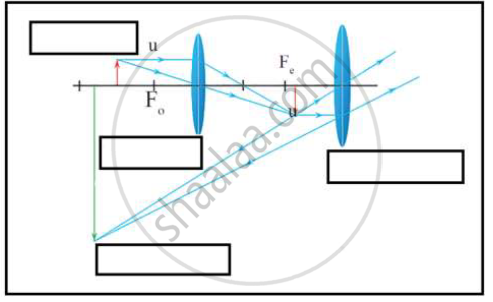
i. Which type of microscope has the arrangement of lenses shown in the adjoining figure?
ii. Label the figure correctly.
iii. Write the working of this microscope.
iv. Where does this microscope used?
v. Suggest a way to increase the efficiency of this microscope.
Advertisements
उत्तर
i. Compound microscope
ii. Scientifically and technically correct figure.
(Object, Objective lens, Eye piece, Image)
iii. Magnification is obtained by the combined effect of two
lenses. The magnification occurs in two stages. The image formed by the first lens acts as the object for the second lens. Clear image can be obtained by adjusting the distance between two lenses.
iv. To study small sized objects like blood cells, animal and plant
cells, bacteria.
v. Any relevant remedy (For example, Selection of lens with
appropriate focal length)
APPEARS IN
संबंधित प्रश्न
A student is using a convex lens of focal length 18 cm to study the image formation by it for the various positions of the object. He observes that when he places the object at 27 cm, the location of the image is at 54 cm on the other side of the lens. Identify from the following diagram the three rays that are obeying the laws of refraction and may be used to draw the corresponding ray diagram.

(A) 1, 2 and 4
(B) 1, 3 and 5
(C) 2, 4 and 5
(D) 2, 3 and 4
Write one condition where it does not bend when entering a medium of different optical density.
Draw a labelled ray diagram to show how a ray of light is refracted when it passes:
from an optically denser medium into air.
Draw a labelled ray diagram to show how a ray of light passes through a parallel-sided glass block if it hits the glass block at an angle other than 90° (that is, obliquely to the glass block).
Describe with the help of a ray diagram the nature, size and position of the image formed when an object is placed at infinity (considerable distance) in front of a convex lens. State three characteristics of the image so formed.
Find the nature, position and magnification of the images formed by a convex lens of focal length 0.20 m if the object is placed at a distance of:
0.15 m
Which part causes the greatest convergence?
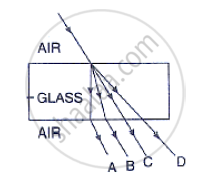
In figure , name the ray which represents the correct path of light while emerging out through
a glass block.
The diagrams (a) and (b) in Figure below show the refraction of a monochromatic ray of light through a parallel sided glass block and a prism respectively. In each diagram, label the incident, refracted emergent rays and the angle of deviation.

A parallel oblique beam of light falls on a convex lens. Draw a diagram to show the refraction of light through the lens.
A convex lens forms an image of an object equal to the size of the object. Draw a diagram to illustrate it.
A lens forms an upright and magnified image of an object State whether the image is real or virtual
Out of the five incident rays shown in the figure find the three rays that are obeying the laws of refraction and may be used for locating the position of image formed by a convex lens:
(A) 1, 2 and 3
(B) 2, 3 and 4
(C) 3, 4 and 5
(D) 1, 2 and 4
An object is placed perpendicular to the principal axis of a convex lens of focal length 20 cm. The distance of the object from the lens is 30 cm. Find (i) the position (ii) the magnification and (iii) the nature of the image formed.
State the position of object, position of image, nature of image when: Convex lens is used as objective lens of astronomical telescope.
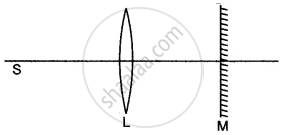
In the figure given below L is a convex lens, M is a plane mirror and S is a point source of light. Rays of light from the source S return to their point of origin. Complete the ray diagram to show this. What is the point S called?
Differentiate convex lens and concave lens.
A convex lens of focal length 20 cm can produce a magnified virtual as well as real image. Is this a correct statement? If yes, where shall the object be placed in each case for obtaining these images?
Distinguish between Concave lens and Convex lens.
Distinguish between:
Concave lens and Convex Lens
