Advertisements
Advertisements
प्रश्न
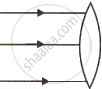
Observe the following figure and answer the questions.

a) Which optical instrument shows arrangement of lenses as shown in the figure?
b) Write in brief the working of this optical instrument.
c) How can we get different magnifications in this optical instrument?
d) Draw the figure again and labelled it properly
Advertisements
उत्तर
a) Arrangement of lenses shown in the figure is refracting telescope.
b) 1) object lens collect the light coming form the distant object and forms the image
2)The image works as object for the eye piece which forms the final image.
c) We can get different magnifications by using the eye piece with different focal lengths.
d)
APPEARS IN
संबंधित प्रश्न
A student focuses the image of a well-illuminated distant object on a screen using a convex lens. After that, he gradually moves the object towards the lens and each time focuses its image on the screen by adjusting the lens.
(i) In which direction, towards the screen or away from the screen, does he move the lens?
(ii) What happens to the size of the image? Does it decrease or increase?
(iii) What happens to the image on the screen when he moves the object very close to the lens?
A student wants to project the image of a candle flame on the walls of school laboratory by using a lens:-
(a) Which type of lens should be use and why?
(b) At what distance in terms of focal length 'F' of the lens should be place the candle flame so as to get (i) a magnified, and (ii) a diminished image respectively on the wall?
(c) Draw ray diagram to show the formation of the image in each case?
An object 5 cm is placed at a distance of 20 cm in front of a convex mirror of radius of curvature 30 cm. Find the position, nature and size of the image.
An object is placed at a distance of 12 cm from a convex lens of focal length 8 cm. Find :
1) the position of the image
2) nature of the image
What type of lens is shown in the diagram on the right? What will happen to the parallel rays of light? Show by completing the ray diagram.
List some things that convex lens and concave mirror have in common.
Calculate the focal length of a convex lens which produces a virtual image at a distance of 50 cm of an object placed 20 cm in front of it.
Find the nature, position and magnification of the images formed by a convex lens of focal length 0.20 m if the object is placed at a distance of:
0.15 m
A student did an experiment with a convex lens. He put an object at different distances 25 cm, 30 cm, 40 cm, 60 cm and 120 cm from the lens. In each case he measured the distance of the image from the lens. His results were 100 cm, 24 cm, 60 cm, 30 cm and 40 cm, respectively. Unfortunately his results are written in wrong order.
- Rewrite the image distances in the correct order.
- What would be the image distance if the object distance was 90 cm?
- Which of the object distances gives the biggest image?
- What is the focal length of this lens?
A lens forms an erect, magnified, and virtual image of an object.
- Name the type of lens.
- Draw a ray diagram to show the formation of the image.
- Where is the object placed in relation to the lens?
- Name the device which uses this principle.
In the following cases, where must an object be placed in front of a convex lens so that the image formed is inverted and enlarged?
If you are to determine to focal length of a convex lens, you should have
(A) a convex lens and a screen
(B) a convex lens and a lens holder
(C) a lens holder, a screen holder and a scale
(D) a convex lens, a screen, holder for them and a scale
Distinguish between:
Concave lens and Convex lens
The image obtained while finding the focal length of convex lens is ....................
A convex lens forms an inverted image of size same as that of the object which is placed at a distance 60 cm in front of the lens. Find: The position of image
Out of the two lenses one concave and the other convex state which is a convergent or a divergent type of a lens. Give a reason for your answer.
Object at 2F1 of a convex lens : Image at 2F2 : : Object at F1 : _______
Convex lens is also known as ______.
Distinguish between:
Concave lens and Convex lens
