Advertisements
Advertisements
Question
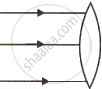
Observe the following figure and answer the questions.

a) Which optical instrument shows arrangement of lenses as shown in the figure?
b) Write in brief the working of this optical instrument.
c) How can we get different magnifications in this optical instrument?
d) Draw the figure again and labelled it properly
Advertisements
Solution
a) Arrangement of lenses shown in the figure is refracting telescope.
b) 1) object lens collect the light coming form the distant object and forms the image
2)The image works as object for the eye piece which forms the final image.
c) We can get different magnifications by using the eye piece with different focal lengths.
d)
APPEARS IN
RELATED QUESTIONS
Which of the following lenses would you prefer to use while reading small letters found in a dictionary?
An object is placed at a distance of 15 cm from a concave lens of focal length 30 cm. List four characteristics (nature, position, etc.) of the image formed by the lens.
Describe with the help of a ray-diagram, the formation of image of a finite object placed in front of convex lens between f and 2f. Give two characteristics of the image so formed.
What type of lens is shown in the diagram on the right? What will happen to the parallel rays of light? Show by completing the ray diagram.
How could you find the focal length of a convex lens rapidly but approximately?
Which type of lenses are:
thicker in the middle than at the edges?
What would be the diameter of the image of the flower on the film?
Draw a diagram to represent the second focus of a convex lens.
A converging lens forms the image of an object placed in front of it, beyond 2F2 of the lens. Draw a ray diagram to show the formation of the image.
In the following cases, where must an object be placed in front of a convex lens so that the image formed is at infinity?
A student focussed the image of a distant object using a device ‘X’ on a white screen ‘S’ as shown in the figure. If the distance of the screen from the device is 40 cm, select the correct statement about the device.
(A) The device X is a convex lens of focal length 20 cm.
(B) The device X is a concave mirror of focal length 40 cm.
(C) The device X is a convex mirror of radius of curvature 40 cm.
(D) The device X is a convex lens of focal length 40 cm.
Out of the five incident rays shown in the figure find the three rays that are obeying the laws of refraction and may be used for locating the position of image formed by a convex lens:
(A) 1, 2 and 3
(B) 2, 3 and 4
(C) 3, 4 and 5
(D) 1, 2 and 4
(a) What type of a lens can be used as a magnifying glass?
(b) Show by a ray diagram the formation of a real image by simple magnifying lens.
State the position of object, position of image, nature of image when: Convex lens is used in cine projector.
_______ is a combination of two convex lenses with small focal length.
Find the odd one out and give its explanation.
Find the odd one out and give its explanation.
Which of the following statements is true?
