Advertisements
Advertisements
Question
Find the odd one out and give its explanation.
Options
Simple microscope
Compound microscope
Telescope
Prism
Advertisements
Solution
Prism
Explanation-
Prism disperses light while other optical instruments produce magnified images of objects.
APPEARS IN
RELATED QUESTIONS
An object 5 cm in length is held 25 cm away from a converging lens of focal length 10 cm. Draw the ray diagram and find the position, size and the nature of the image formed.
An object of height 4.0 cm is placed at a distance of 30 cm from the optical centre 'O' of a convex lens of focal length 20 cm. Draw a ray diagram to find the position and size of the image formed. Mark optical centre 'O' and principal focus 'F' on the diagram. Also find the approximate ratio of size of the image to the size of the object.
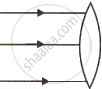
What type of lens is shown in the diagram on the right? What will happen to the parallel rays of light? Show by completing the ray diagram.
How could you find the focal length of a convex lens rapidly but approximately?
Find the nature, position and magnification of the images formed by a convex lens of focal length 0.20 m if the object is placed at a distance of:
0.25 m
An object is placed 20 cm from (a) a converging lens, and (b) a diverging lens, of focal length 15 cm. Calculate the image position and magnification in each case.
A lens forms an inverted image of an object. Name the kind of lens.
An object is placed perpendicular to the principal axis of a convex lens of focal length 20 cm. The distance of the object from the lens is 30 cm. Find (i) the position (ii) the magnification and (iii) the nature of the image formed.
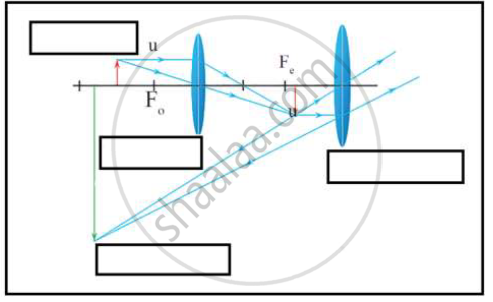
i. Which type of microscope has the arrangement of lenses shown in the adjoining figure?
ii. Label the figure correctly.
iii. Write the working of this microscope.
iv. Where does this microscope used?
v. Suggest a way to increase the efficiency of this microscope.
Where should an object be placed in front of a convex lens to get a real image of the size of the object?
Where must a point source of light be placed in front of a convex lens so as to obtain a parallel beam of light?
What is the difference between a double convex and a bi-convex lens?
State the position of object, position of image, nature of image when: Convex lens is used as in searchlight.
A candle is placed between f and 2f a convex lens. Draw a ray diagram showing the position of the image.
Can one bum a piece of paper in daylight by just using a convex lens instead of a match or any direct flame? Support your answer with the help of an appropriate ray diagram.
_______ times larger images can be obtained by using a simple microscope.
_______ is a combination of two convex lenses with small focal length.
Write the name.
The lens used in simple microscope.
Distinguish between:
Concave lens and Convex Lens
